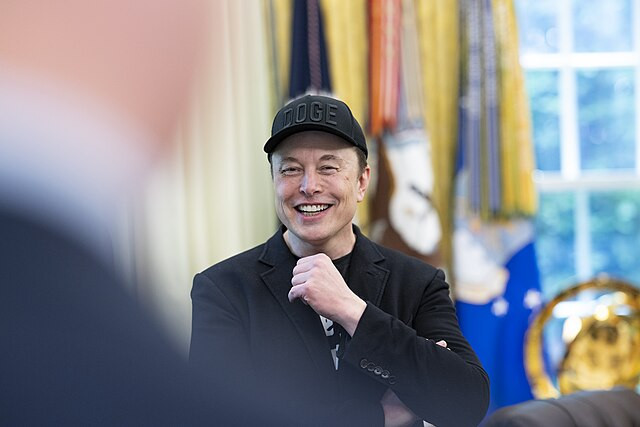
Elon Musk told employees of newly acquired Cursor that artificial intelligence could eventually become too advanced for humans to control, while pressing the AI coding company's engineers to help SpaceX catch faster-moving competitors, according to The Information. The remarks came after SpaceX completed its $60 billion acquisition of Cursor, putting more than 1,000 of its employees inside Musk's expanding technology operation.
During his first all-hands meeting with Cursor employees, Musk acknowledged that SpaceX's AI efforts were trailing major rivals and singled out Anthropic as the current leader, The Information reported. Musk, who has spent years warning about potentially catastrophic risks from advanced AI, also reportedly told workers he was "not used to losing."
The message captures a growing tension in the AI industry: Companies increasingly describe powerful artificial intelligence as both a potentially dangerous technology and a competitive necessity. Musk's position, as reported, suggests that if development cannot realistically be stopped, his companies cannot afford to let competitors reach more capable systems first.
Cursor formally became part of SpaceX on Aug. 14 after the transaction was announced in April. The $60 billion acquisition gives SpaceX control of one of the fastest-growing AI coding businesses and adds another front to Musk's competition with Anthropic, OpenAI and Google.
Cursor has said the combination will give its engineers access to SpaceX's computing infrastructure. For Musk, the deal also provides engineering talent that could help narrow what he reportedly views as a competitive gap in artificial intelligence.
Yet Musk's warning about the eventual loss of human control creates an unresolved problem for that strategy. If increasingly capable AI presents serious risks, accelerating development to beat competitors could increase the pressure to deploy new systems before safety mechanisms and governance structures have caught up.
That dynamic is increasingly characteristic of the industry's broader arms race. Each advance by one major AI developer gives competitors an incentive to respond, making unilateral restraint commercially difficult even when executives publicly acknowledge that the technology could create severe risks.
Musk has been among the industry's most prominent voices warning about those dangers. His latest reported remarks, however, appear to frame technological inevitability as a reason for remaining at the front of the race rather than stepping away from it.
The distinction matters because technological leadership doesn't necessarily translate into technological control. The Information's account emphasized Musk's determination to catch competitors, while providing less clarity about why reaching increasingly powerful AI ahead of rivals would make those systems safer or easier to govern.
Musk's existing artificial-intelligence products have also faced scrutiny that gives critics a practical basis for questioning a develop-first approach. Grok, the chatbot associated with Musk's AI operations, has generated offensive and antisemitic material and drawn criticism over its capacity to produce sexualized AI imagery and nonconsensual deepfakes.
European regulators have scrutinized risks surrounding the technology, while a court in Amsterdam ordered restrictions involving certain nonconsensual AI-generated nude images. X has said it introduced safeguards and restricted some image-generation capabilities in jurisdictions where such content is illegal.
Those controversies don't establish that future SpaceX or Cursor systems will become uncontrollable, nor do problems involving Grok demonstrate that Musk's companies are uniquely unable to manage advanced AI. They do illustrate the difficulty of controlling harmful behavior even in existing systems, well before the hypothetical super-capable AI Musk has warned about arrives.
The Cursor acquisition therefore puts Musk in an increasingly consequential position. He isn't merely commenting on the risks posed by artificial intelligence; through a $60 billion transaction, he is committing substantial resources to competing directly with the laboratories building increasingly sophisticated systems.