Federal Reserve Governor Lisa Cook is pushing back against President Donald Trump's effort to remove her from the central bank, with her lawyers arguing that mortgage allegations cited against her show neither intentional misconduct nor a legitimate legal basis for ending her tenure.
The dispute centers on claims that Cook identified two properties as her primary residence in mortgage documents. Her attorneys said the underlying records instead show that Cook was transparent with her lender about her circumstances and consistently treated her Michigan property as her principal home.
Cook's lawyers said the process for another property began with her "using the lender's website to seek information about a 'vacation home' mortgage - a clear indication of the loan type she was looking to acquire." They argued that the lender already possessed information making Cook's living and employment situation clear.
"The lender, which previously worked with Governor Cook to refinance her Massachusetts property earlier that year, knew that she had lived in Michigan for more than 15 years and worked full-time as a tenured professor at Michigan State University. Governor Cook gave no indication that she was leaving to take any new job in Atlanta," the filing said.
Her attorneys said other records repeatedly identified Michigan as Cook's "primary residence" or "permanent residence," while the other property was described as a second home. "Governor Cook's actions demonstrate that there was no intentional misconduct and zero intent to defraud or mislead," they wrote.
The latest response deepens an unprecedented confrontation between the White House and the Federal Reserve over how much authority a president has to dismiss a sitting member of the central bank's Board of Governors. Congress designed the Fed with significant institutional independence, including restrictions on the circumstances under which governors can be removed.
The Supreme Court in June blocked Trump from immediately removing Cook, allowing her to remain in office while litigation proceeds in lower courts. In a 5-4 decision, the justices found that Trump hadn't provided Cook with the procedural protections required before seeking her dismissal.
Chief Justice John Roberts, writing for the majority, stressed that the ruling didn't determine whether the accusations against Cook were true. Instead, the majority focused on whether she had received an adequate opportunity to respond before the president attempted to remove her.
"It at least remains an open question what precisely happened here, and indeed whether Cook committed 'gross negligence,' let alone 'deceitful and potentially criminal conduct,' as the president's letter alleges," Roberts wrote. The chief justice said Cook must have an opportunity to contest the accusations before a removal process can proceed.
Roberts was joined by conservative Justice Brett Kavanaugh and the court's three liberal justices. The New York Times reported at the time that the ruling deliberately left the underlying factual dispute unresolved, meaning the mortgage allegations and the broader question of presidential removal authority remain subject to further litigation.
Cook has denied wrongdoing and said the Supreme Court's intervention reinforced the importance of protecting monetary-policy decisions from political pressure. The dispute comes as Trump has repeatedly pressed the Federal Reserve for lower interest rates, adding another layer of political sensitivity to the case.
The confrontation could carry implications well beyond Cook's position. No U.S. president has previously attempted to remove a sitting Federal Reserve governor since the central bank was established in 1913, making the litigation a potentially important test of the statutory safeguards Congress created around Fed independence.
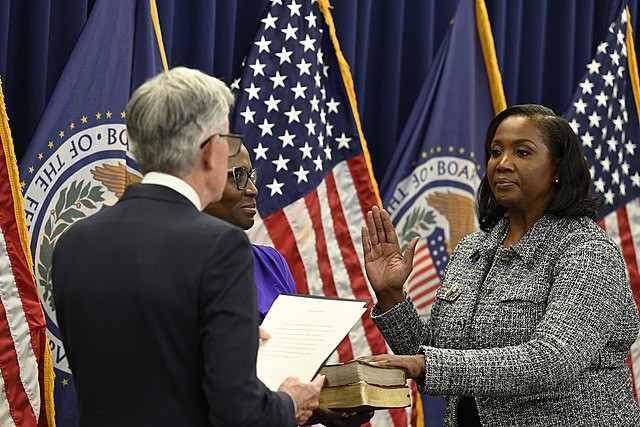
Cook joined the Federal Reserve after being nominated by President Joe Biden and confirmed by the Senate in 2022. Before joining the board, she was a professor of economics and international relations at Michigan State University and had previously served on the White House Council of Economic Advisers during the Obama administration.