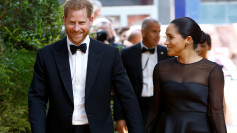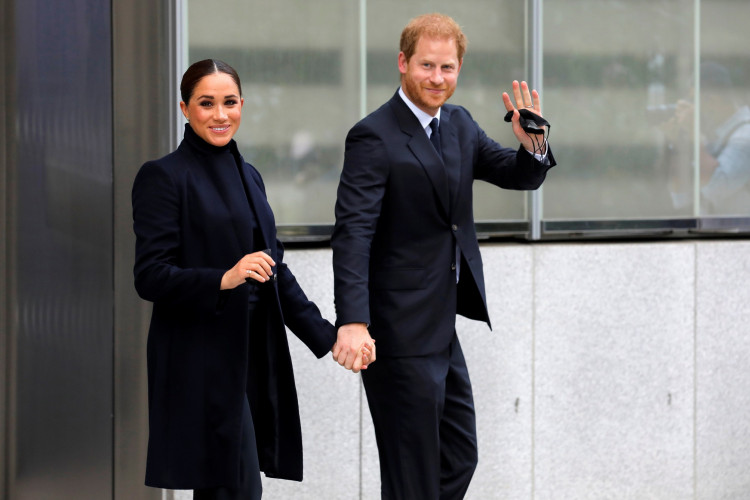
Prince Harry and Meghan Markle have returned to Britain with their children but without automatic taxpayer-funded police protection, reviving a long-running dispute with the U.K. government as the Duke and Duchess of Sussex begin what is reported to be a permanent move back after six years in California.
The family arrived Wednesday at Birmingham Airport aboard a chartered business jet with Prince Archie and Princess Lilibet. Instead of receiving a police convoy for the journey from the airport, Harry was reportedly provided with the telephone number of a police liaison officer and left in a privately secured Mercedes-Benz V220d.
The Sussexes are unhappy with the arrangement, according to the supplied report, and Harry has instructed his lawyers to contact Home Secretary Shabana Mahmood seeking urgent intervention. The Home Office is said to be "actively assessing" his circumstances following the family's relocation, though IBTimes UK said it couldn't independently verify that claim.
The dispute is potentially more consequential now that Harry and his family are expected to spend substantially more time in Britain. The Sussexes lost their automatic publicly funded police protection after stepping down as working members of the Royal Family in 2020 and moving to North America.
Harry has repeatedly argued that private security can't reproduce the intelligence access, firearms capabilities and coordination available to specialist British police. His legal challenges to the government's approach have made his protection arrangements one of the most contentious issues surrounding his relationship with Britain since his royal departure.
For now, David Langdown, described as Harry's longtime security adviser and friend, is overseeing the family's protection. A dedicated team of privately funded British security personnel has reportedly been assembled to cover the gap left by the absence of automatic police protection.
Scott Hamer, a former royal protection officer who previously guarded King Charles, said the arrangement leaves the Sussexes "in danger." He called the decision to provide Harry with little more than a police contact number "absolutely incredible."
"We currently have eight non-working prime ministers who are in receipt of police protection that is paid for by the public," Hamer said, arguing that Harry's threat profile warrants reconsideration.
Hamer specifically contrasted Harry's situation with that of former Prime Minister Liz Truss. "I am not privy to the intelligence regarding Liz Truss," he said. "But having been prime minister for 49 days, I would argue that Prince Harry should be in receipt of protection."
Decisions over protection for members of the Royal Family and other prominent public figures are handled through the Executive Committee for the Protection of Royalty and Public Figures, commonly known as Ravec. The committee assesses security according to perceived risks rather than simply granting protection based on royal status.
Ravec reportedly conducted a fresh assessment of the Sussex family at the end of July. Harry then provided the required 28 days' notice ahead of his return, but according to the supplied account, he hadn't been told the committee's final determination before arriving at Birmingham Airport.
The family's permanent presence in Britain could require officials to revisit an assessment previously shaped around Harry's status as a U.S.-based former working royal making occasional visits. Government officials are reportedly considering his changed circumstances, though no decision restoring automatic state-funded protection has been announced.
Until then, the Sussexes will continue paying for private protection. Their travel arrangements carry additional costs: the charter aircraft used for their return is estimated in the report to cost roughly £9,000 for each flying hour, although the precise cost of the family's flight hasn't been independently confirmed.
The move also represents a significant reversal in the Sussexes' post-royal life. After establishing themselves in Montecito, Calif., Harry and Meghan now reportedly plan to operate as an "international" family while retaining properties in California and Portugal and establishing their primary British residence outside London.
Archie and Lilibet have reportedly been enrolled in British schools and are expected to begin classes next week. The children recently visited Highgrove, where they were said to have reunited with King Charles for the first time in four years.
The return could also create more opportunities for Harry to reconnect with the Royal Family after years of strained relations, particularly with Prince William. The brothers' relationship deteriorated around Harry's marriage to Meghan and worsened following the Sussexes' televised interviews and allegations in Harry's memoir.