Jordan and Israel will work together to save the dying Dead Sea with $1.5 billion budget. The religious site continuously declines, and some experts believe that it may be gone by 2050.
The Dead Sea now has contaminated water, but it still attracts a lot of tourists. Some of the pilgrims even hold their baptism ceremonies in this area.
Although the government is very much aware of the problem, according to National Geographic, it only put a small warning near its parking lot that says its water is not "potable." The Dead Sea had started to decline in the 1960s when Israel built a pumping station to divert water from the Jordan River to the Sea of Galilee.
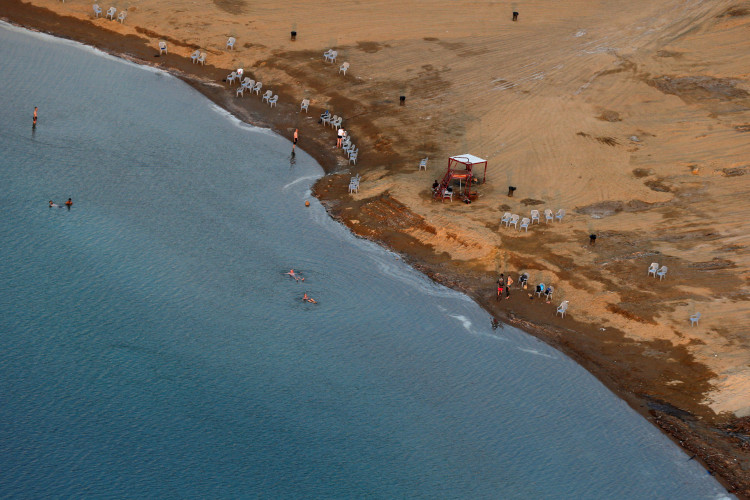
Israel's Environmental Protection Ministry reported that the Dead Sea is receding at a four feet rate every year. It is now only 30 miles long from its usual 50 miles long from the 1950s.
Israel's neighbor countries, Lebanon, Syria, and Jordan, also benefit from its bodies of water. So solving the Dead Sea's problems requires cooperation from these nations. "It's not just an economic problem or an ecological problem. It's a geopolitical problem," Israel's Environmental Protection Ministry senior director Galit Cohen said.
Government officials see climate change and the 15-year drought as the culprit to Dead Sea's decline. But, environmentalists and scientists see it as "human-caused," and mostly because of the government's negligence.
The Dead Sea's damage also creates sinkholes that affect buildings and roads. Its seaside landscape also deteriorates. Some experts believe it will possibly disappear in 2050, while others deem it will survive and leave a fraction of its original size.
However, there is now a growing effort to save the Dead Sea from dying. The $1.5-billion project aims to build a "desalination facility" in Jordan to transform the Red Sea's water into drinking water. Its salty brine, on the other hand, will be pumped to the Dead Sea, per NBC News.
The Red Sea-Dead Sea project is expected to solve a lot of water issues. It will solve the freshwater problem, stabilize the Dead Sea's levels, and finally set a "high bar for peace and collaboration" between Israel, Jordan, and the Palestinians.
The project group director Nabil Zoubi said that Israel and Jordan would pay the one-third of the bill with the help of a grant from the U.S. government. The two countries also loan from the French development fund, European Commission, and the Italian and Spanish governments. The private sector would handle the remaining two-thirds of the fund.
Zoubi also revealed that the Red Sea-Dead Sea project would soon open to bidders; they only need to polish few technical issues. Its construction might start in early 2021 and finish after three-and-a-half years.