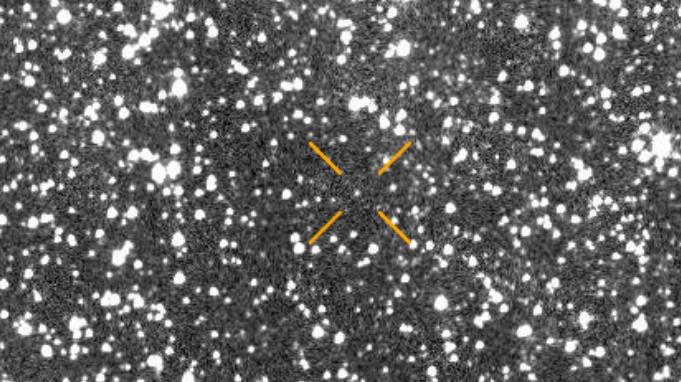
Comet 3I/ATLAS, the third confirmed interstellar object to enter the solar system, is prompting renewed scientific debate after astronomers observed unexpected behavior during its close approach to the Sun in late October. The signs of non-gravitational acceleration and a striking color shift echo anomalies first noted in the 2017 object 'Oumuamua, an event that led some researchers to explore explanations beyond natural astrophysical processes.
3I/ATLAS was first detected on July 1, 2025, by the ATLAS survey telescope in Chile. Its hyperbolic trajectory and velocity confirm that it originated outside the solar system, similar to 2I/Borisov in 2019 and 'Oumuamua before it. This class of objects has become a rare but increasingly significant window into planetary formation beyond the Sun.
NASA recently classified 3I/ATLAS as a comet, identifying a frozen core surrounded by a visible coma of gas and dust. However, its motion near perihelion-its closest point to the Sun-has drawn intense scrutiny among astronomers. According to observations analyzed in recent weeks, the object demonstrated non-gravitational acceleration inconsistent with forces typically caused by outgassing from evaporating ice.
Avi Loeb, theoretical astrophysicist at Harvard University, has once again put forward a controversial interpretation. Discussing the measured deviation from the expected path, he wrote: "Alternatively, the non-gravitational acceleration might be the technological signature of an internal engine." The comment appears in his recent analysis of the object's movement, in which he argues that the effects cannot yet be fully explained by standard cometary activity.
Loeb pointed to data from the Atacama Large Millimetre Array (ALMA), which recorded a 4-arcsecond departure from projected orbital positioning. The observed acceleration was more forceful than what would be expected from sublimation-driven propulsion, the mechanism that causes ordinary comets to shift slightly when warmed by sunlight.
In addition to its motion, astronomers noted that 3I/ATLAS underwent a highly unusual color change, shifting from a reddish appearance to a distinct blue near perihelion. This optical variation coincided with a rapid brightening event believed to be linked to the release of material from the comet's surface.
Such departures from typical cometary behavior have placed 3I/ATLAS at the center of debate about how interstellar objects form and how they survive long journeys between star systems. While many researchers attribute the acceleration to extreme heating and volatile loss as the object passed close to the Sun, others view the data as evidence that existing cometary models are incomplete.