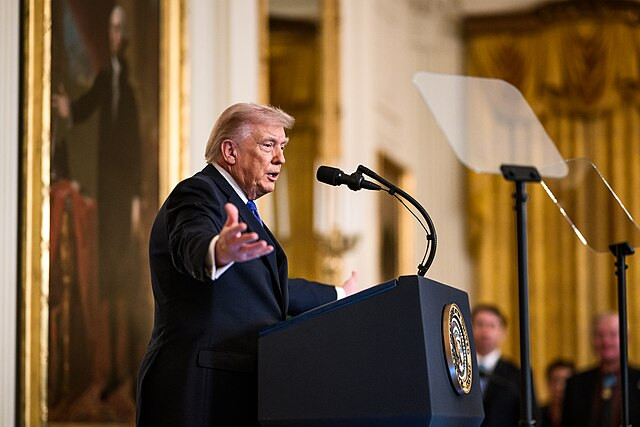
President Donald Trump, the U.S. Department of Defense, and the southern Iranian city of Minab have become the focus of international scrutiny after a missile strike on an elementary school killed at least 175 people, many of them children, during the opening phase of the current U.S.-Iran conflict. Asked by reporters about a military review suggesting the United States may have been responsible, Trump responded briefly: "I don't know about it."
The remark, delivered during a press exchange with journalists, quickly circulated across global media as questions mounted over the Feb. 28 strike on Shajareh Tayyebeh elementary school. The attack occurred during a U.S.-led military campaign targeting Iranian military infrastructure and facilities connected to the Islamic Revolutionary Guard Corps (IRGC).
Early reporting on the strike indicated the school was located near buildings used by IRGC naval forces, raising concerns that targeting data may have misidentified civilian structures as military installations. According to preliminary findings cited in coverage of the investigation, analysts reviewing the incident believe outdated intelligence data may have played a role in the strike.
Defense officials have emphasized that the investigation remains ongoing and that no final determination has been made regarding responsibility for the attack.
Investigators and independent analysts examining satellite imagery and video evidence say the weapon used in the strike appears consistent with a Tomahawk cruise missile, a system primarily deployed by the U.S. Navy. The missiles are manufactured by Raytheon Technologies and are used by a limited number of U.S. allies.
The technical characteristics of the weapon have drawn attention because few countries possess Tomahawk missiles and none are known to be conducting strikes inside Iran during the current conflict.
The emerging evidence has complicated earlier suggestions from Trump that Iranian forces themselves might have caused the strike. During initial comments about the incident, Trump suggested that Iran's own military could have mistakenly struck the site due to inaccurate munitions.
As further analysis surfaced indicating the possible use of a Tomahawk missile, Trump was again asked about the incident by reporters. His response - "I don't know about it" - quickly became the defining line of the administration's public reaction to the controversy.
The Pentagon has since indicated that the strike remains under review as part of its broader assessment of early operations in the conflict. Defense officials have cautioned that preliminary intelligence should not be treated as definitive while investigators continue examining targeting data and operational logs.
The Minab incident has drawn international attention because of the scale of civilian casualties and the symbolic significance of a school being struck during wartime operations. Civilian deaths in conflicts involving advanced precision weapons often prompt scrutiny over intelligence accuracy and targeting procedures.
The strike also comes at a moment of heightened geopolitical tension surrounding the war between the United States and Iran. The conflict has already affected global markets and strategic infrastructure across the region.
The Strait of Hormuz, a critical shipping route for energy exports, remains under heavy security concerns as naval forces from multiple countries monitor the situation. Meanwhile, global energy markets have reacted sharply to the escalation.
Civilian casualties have historically been among the most politically sensitive aspects of modern warfare. When incidents involve locations such as schools or hospitals, the diplomatic consequences can extend beyond the battlefield and shape international perceptions of a military campaign.
The Minab strike has therefore become a focal point not only for military investigators but also for foreign governments, humanitarian organizations and analysts examining the broader trajectory of the U.S.-Iran conflict.