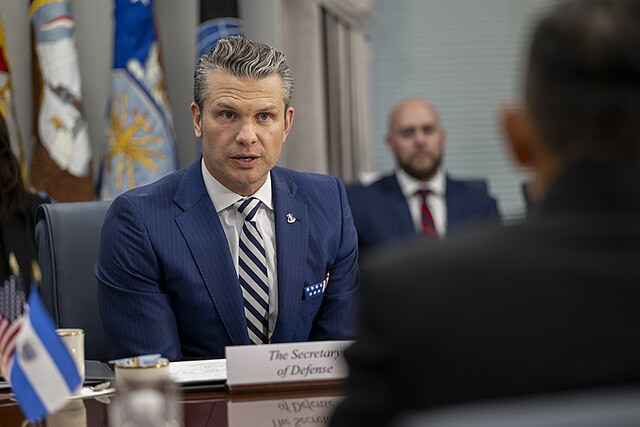
Pete Hegseth triggered confusion inside the Pentagon and alarm among NATO allies after abruptly halting a planned U.S. troop deployment to Poland, with American officials admitting they were given little warning before the decision upended months of military planning.
"We had no idea this was coming," one U.S. official said, describing what several people familiar with the matter characterized as a frantic effort among American and European officials to understand whether the canceled Poland mission was an isolated move or part of a broader drawdown across Europe.
The deployment involved Texas-based troops scheduled for a nine-month rotational assignment in Poland alongside NATO partners. According to officials cited by Politico, portions of the unit and some equipment had already begun arriving in Europe before the order came down.
The sudden reversal intensified concerns inside NATO that the Trump administration is accelerating efforts to reduce America's military footprint across the continent at a moment of heightened geopolitical instability tied to Iran, Russia and Eastern European security.
The decision also followed another controversial Pentagon announcement just weeks earlier involving the planned withdrawal of roughly 5,000 U.S. troops from Germany. Taken together, the moves have fueled growing anxiety among European governments that Washington is fundamentally reshaping its defense posture toward longtime allies.
Neither the Pentagon nor the White House publicly detailed why the Poland deployment was stopped. Acting Pentagon press secretary Joel Valdez disputed reports portraying the move as chaotic or improvised.
"The decision followed a comprehensive, multilayered process" and "was not an unexpected, last-minute decision," Valdez said.
That explanation, however, appeared to clash with reactions from lawmakers, foreign officials and even personnel inside the U.S. government. Democratic Sen. Jeanne Shaheen, a member of the Senate Armed Services Committee, said Congress had not been briefed "as far as I know."
Polish officials also acknowledged they were caught off guard. Władysław Kosiniak-Kamysz attempted to calm public concerns Friday by insisting the U.S.-Poland alliance remained "durable and lasting" and said the change would not weaken Polish security.
Polish Prime Minister Donald Tusk said Washington assured him the cancellation was "of a logistical nature" and would not affect NATO deterrence capabilities on the alliance's eastern flank.
Still, the optics proved difficult for European allies to ignore, particularly because Poland has been one of Washington's strongest military partners inside NATO. The country currently spends nearly 5% of its GDP on defense - the highest percentage in the alliance - and has consistently supported U.S. security initiatives in Eastern Europe.
Hegseth himself previously praised Poland as a "model ally," making the abrupt cancellation even more surprising to officials in Warsaw and Brussels.
President Donald Trump has repeatedly argued that European governments rely too heavily on American military protection and should shoulder a greater share of defense costs themselves.
Trump recently suggested troop cuts in Europe could extend beyond Germany and Poland, while also criticizing several NATO countries over support for the administration's policies tied to the Iran conflict.
"This is a major challenge to Europe's security and a severely disrupting way of shifting responsibility to Europeans," former Finnish official Joel Linnainmäki told Politico.