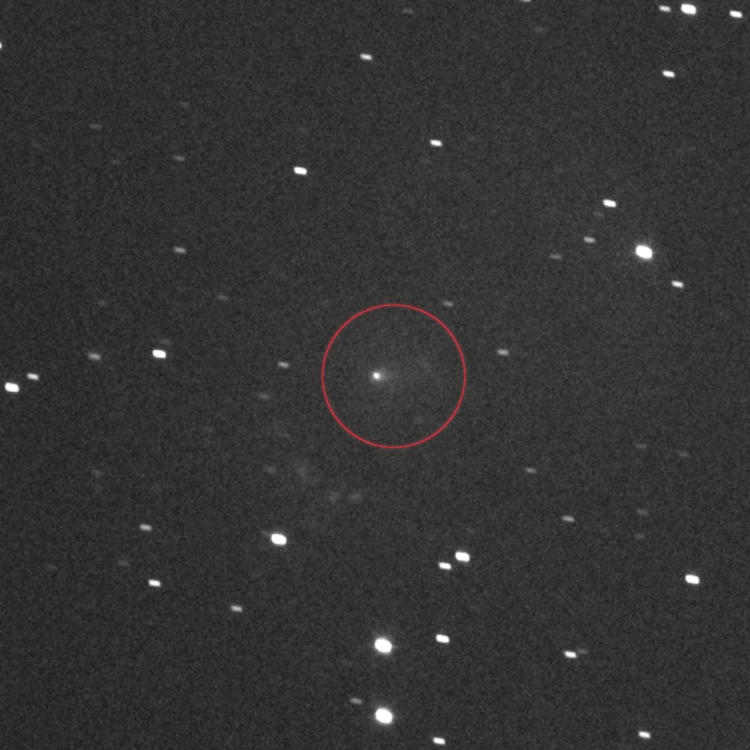
(Photo: NASA/Goddard/SwRI/JHU-APL)
Astronomers are reporting new findings about 3I/ATLAS, the rare interstellar comet now moving through the outer solar system, as NASA and research institutions expand monitoring of the object's unusual metal-rich composition and signs of cryovolcanic activity. The comet-only the third confirmed interstellar visitor after Oumuamua and 2I/Borisov-has drawn significant interest from scientists and investors as new spectroscopic data reveal features unlike those of typical Solar System bodies.
The heightened attention follows recent analyses that identified unexpectedly high levels of atomic nickel in the comet's coma at a distance of 3.9 astronomical units. A report in Astrobiology described the object as containing "an unusually high metal content," while additional measurements have highlighted a nearly pristine carbonaceous composition. The findings suggest that 3I/ATLAS may have remained in deep freeze for billions of years in a distant, isolated stellar environment before entering the solar system.
Researchers say the material's condition offers a rare opportunity to examine primordial compounds formed around another star. Telescopes including the Very Large Telescope and the James Webb Space Telescope have documented chemical signatures indicating that the comet contains volatile organometallic compounds capable of releasing nickel and carbon monoxide at low temperatures. The James Webb Space Telescope measured a carbon dioxide-to-water ratio of roughly 8:1, contributing to the view that the comet's internal structure may support cryovolcanic eruptions.
Such eruptions could create jets of sublimating gases-similar to volcano-like activity-that add uncertainty to the comet's trajectory and complicate long-term modelling. Scientists argue that these processes may also provide clues about the chemical pathways that shaped the building blocks of planets in other star systems. Because of its interstellar origin, 3I/ATLAS may contain compounds or temperature thresholds not observed in comets formed inside the Sun's gravitational domain.
The scientific attention has spilled into the business community, where firms tied to space imaging, spectroscopic analysis, and astronomical data processing have seen rising interest. Investors have tracked NASA's release of new images and data, viewing the mission surge as a potential catalyst for companies specialising in advanced sensors, optical technologies, or space-based observation software.
Market analysts say expanding federal investment in space data-particularly for fast-moving, one-time interstellar objects-may influence valuations for firms that partner with NASA or contribute to high-resolution tracking platforms. The comet's passage, they argue, has reinforced the importance of real-time observation networks capable of capturing fleeting phenomena.
Beyond financial implications, scientists are considering how 3I/ATLAS could reshape long-term exploration strategy. Space agencies in the U.S. and Europe have been evaluating whether future missions should be designed to intercept interstellar objects, which travel at high velocities and often appear with limited warning. The complexity of 3I/ATLAS, along with its cryovolcanic behaviour, has renewed interest in mission concepts capable of capturing direct samples.
Federal funding discussions increasingly reflect the view that interstellar visitors may offer unparalleled scientific returns, as their compositions are not shaped by the Sun's radiation or by repeated orbital cycles. Researchers say missions targeting such objects could inform theories about the diversity of planetary systems and the chemical origins of organic material beyond Earth.
The unusual chemical profile of 3I/ATLAS has also prompted debate within academic circles about whether the comet represents a common type of interstellar debris or an exceptionally rare specimen. Its metal-rich vapours and high carbon content challenge existing models of comet evolution, raising questions about the range of materials that can form in distant protoplanetary disks.