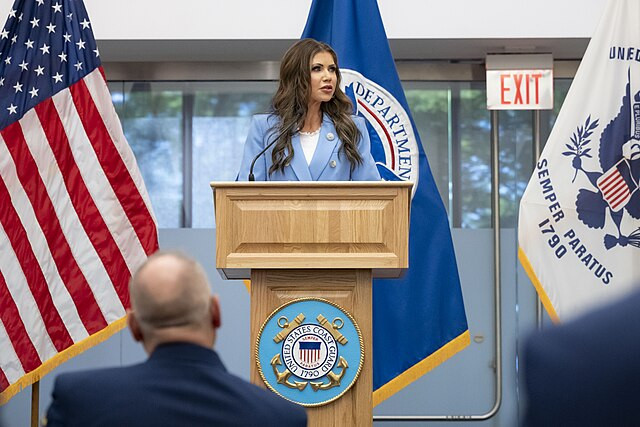
A new analysis of federal court filings is challenging claims by the Trump administration and Homeland Security Secretary Kristi Noem that assaults against Immigration and Customs Enforcement officers have surged by more than 1,000%, reframing the debate over whether public violence is rising or whether enforcement tactics themselves are escalating confrontations. The Los Angeles Times review of cases involving ICE, DHS and Border Patrol agents in major jurisdictions found increases far smaller than the administration's public figures, intensifying questions around how data is being deployed to justify aggressive deportation operations.
Homeland Security officials have repeatedly pointed to 238 assaults on ICE agents this year compared with 19 over the same period last year, a metric presented by the administration as evidence of what former President Trump has called "domestic terrorism." But the Times analysis of federal court records in Los Angeles, San Diego, Portland, Chicago and Washington, D.C., found only a 26% rise in assault-related cases, with 163 filed this year versus 129 last year. In roughly 60% of cases, ICE or Border Patrol personnel were listed as victims, but more than half involved no injury, and another 30% resulted only in minor bruising. Just 16% of cases involved more serious harm.
Scholars and former officials argue the administration's enforcement approach-particularly Noem's directive to widen daytime and public-space operations-is playing a central role. Charis Kubrin, a professor at UC Irvine, said the narrative of skyrocketing violence reflects political dramatization rather than empirical reality. "This is what we call in sociology a moral panic," she said, noting how percentage increases can distort context when the base rate is extremely low.
Former ICE director John Sandweg told the Times that operational shifts are directly contributing to the rise in confrontations. "When you shift those tactics and have agents out there in broad daylight, in Home Depot parking lots, when you have these cities on edge ... it's just going to increase the number of incidents where some sort of an assault happens," he said.
Court filings also show how loosely "assault" can be applied in federal charging. Many defendants were prosecuted after physical contact initiated during arrests, including cases in which individuals were shoved, pinned or grabbed and reacted reflexively. In Chicago, protesters facing charges were accused of "assault" after flailing when pushed by officers. In Los Angeles, a woman was charged after her umbrella struck an agent; a jury later acquitted her. Other listed "weapons" included a tambourine, a hat, a flag and a Subway sandwich.
DHS spokesperson Tricia McLaughlin defended the administration's view, claiming officers were "facing terrorist attacks" and had been shot at, rammed by vehicles and subjected to bomb threats and doxing. She referenced serious injuries in Houston and Nebraska, where one agent was reportedly beaten with a metal coffee cup and another hospitalized. But the Times investigation found that the year's only shooting during an immigration raid occurred when an ICE agent's bullet ricocheted into a deputy marshal's hand in Los Angeles.
More than one-third of the 163 reviewed cases were dismissed or ended in acquittals. In many instances defendants were deported before trial or jurors declined to convict. According to the Times, not a single case has resulted in a trial conviction.
A November Senate hearing revealed widening political division over the administration's data. Senator Alex Padilla criticized the presentation of the statistics, saying: "Today's hearing is not a serious attempt to protect law enforcement. It's designed to fuel the propaganda machine and encourage even more brutal immigration enforcement operations."
Additional scrutiny has focused on internal directives that may contribute to the confrontational dynamic. Border Patrol commander Gregory Bovino was recorded telling agents to "arrest as many people that touch you as you want to," adding: "Everybody f---ing gets it if they touch you. This is our f---ing city." Experts note that such orders blur the line between protest behavior and criminal assault, further complicating the accuracy of assault statistics cited by DHS.