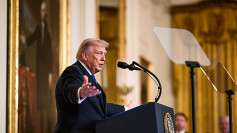
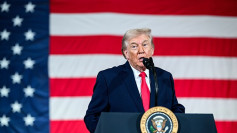
President Donald Trump has no intention of retreating from public life after his second term ends in January 2028 and is instead positioning himself as a global mediator through a newly launched international body, according to Mike Huckabee.
In an interview in Jerusalem, Huckabee said Trump is already planning what he described as his "next project in life," centered on the Board of Peace, a multilateral initiative unveiled at the World Economic Forum in Davos earlier this year. "He's not going to sit in a rocking chair on a front porch and just play golf once a week," Huckabee said. "He's incapable of settling down."
The Board of Peace is scheduled to hold its first formal meeting on Feb. 19 at the United States Institute of Peace in Washington, D.C. The body has received authorization from the United Nations Security Council to oversee certain aspects of the fragile Gaza ceasefire, a development that has prompted unease among some diplomats concerned about overlapping mandates.
Huckabee framed the initiative as a response to what he described as stagnant multilateral processes. "These are people who want to actually do some heavy lifting," he said, contrasting the board's approach with traditional diplomatic channels. He added that the emphasis would be on "concrete outcomes" in regions where negotiations have stalled.
Early engagement with the Board of Peace has reportedly included outreach from Russia, Saudi Arabia and Qatar, reflecting interest among governments that have often favored transactional diplomacy. Western European officials, by contrast, have signaled skepticism about whether a Trump-led structure risks undermining established postwar institutions.
According to planning documents circulated in Davos, permanent membership on the board could be tied to voluntary financial contributions of up to $1 billion, earmarked for reconstruction efforts in conflict zones. Other participants would rotate on fixed terms. Supporters argue that substantial financial commitments align influence with responsibility; critics describe the arrangement as effectively pay-to-play.
The framework echoes proposals advanced by the National Committee for the Administration of Gaza, which has advocated a business-oriented model for post-conflict governance. Huckabee suggested that such pragmatism reflects Trump's preference for deal-making over what he sees as bureaucratic inertia.
Beyond institutional design, the project carries personal stakes. Huckabee said Trump wants to be remembered as a "peacemaker," citing Middle East normalization agreements during his administration as evidence of his diplomatic instincts. The ambassador also raised the possibility that Trump could chair the Board of Peace on an "indefinite" basis after leaving office.