(Photo: NASA/Goddard/SwRI/JHU-APL)
Astronomers are racing to understand a puzzling rhythmic signal coming from 3I/ATLAS, the interstellar object now moving through the inner solar system, after new observations revealed a striking 16.16-hour periodic pulse in its brightness. The finding, highlighted by Harvard astrophysicist Avi Loeb, positions the object at the center of an increasingly urgent scientific debate over whether the variability reflects natural cometary activity or something far more unusual.
Since its detection in July 2025, the object's light curve has shown what researchers describe as a repeating "heartbeat," a consistent pattern that has little precedent among known comets and raises fundamental questions about the source of the signal.
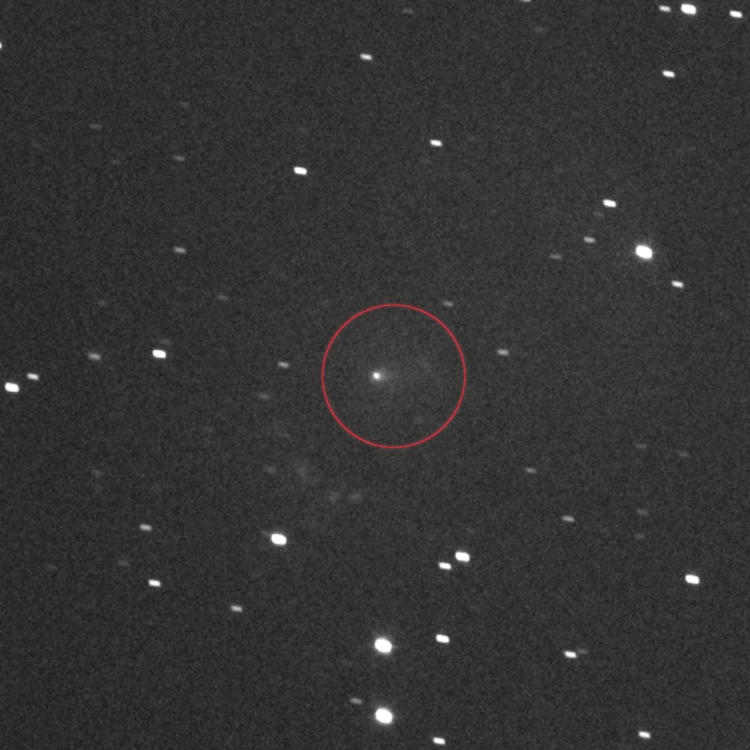
The light variation was first formally reported by T. Santana-Ross and colleagues, who measured an amplitude of about 0.3 magnitudes. Scientists initially attempted to link the pulse to a rotating nucleus with an elongated shape, but Loeb and others argue that such a model is inconsistent with the available imaging. A Hubble Space Telescope photograph taken on July 21 revealed that most of the light originates not from the nucleus but from a broad, glowing halo of dust and gas surrounding the object.
Because the nucleus could not be resolved, its true size remains uncertain, and calculations show that if the nucleus were responsible for the observed brightness, it would require an effective radius as large as 23 kilometers-far larger than expected for an object emitting so much material.
The paradox, Loeb argues, lies in the fact that the nucleus likely reflects "less than a percent of the total light," making it impossible for the rotational spin of a small body to explain such dramatic variations. That assessment has shifted scientific attention to the coma itself, where recent imagery shows several collimated jets of material streaming outward.
Loeb notes that if these jets pulse as the nucleus rotates, "the resulting coma would display periodic variability in its scattering of sunlight." The jets' behavior, he writes, "literally resembles a heartbeat," with each brightening episode acting as a burst of gas and dust expanding outward.
The physics behind such a process is consistent with known comet activity. If a volatile-rich pocket lies on one side of the nucleus, solar heating on each rotation could trigger a periodic jet, producing the observed rhythm. Calculations using a 440-meter-per-second outflow velocity-cited in a Webb telescope report-suggest the material could travel 25,600 kilometers during each cycle, a scale large enough to dominate the visible coma.
Yet the question that has fueled growing attention is whether these jets behave like a natural phenomenon or could indicate a technological process. Loeb notes that the answer rests on a critical test: the orientation of the jets relative to the sun. He writes that for a natural comet, "the active jet must point towards the sun," whereas for a technological object "the direction of the pulsing jet could be arbitrary." Despite the significance of this distinction, Loeb emphasizes that "none was systematically studied in the published literature," leaving scientists without the observational evidence required to determine the pattern's origin.
The lack of systematic, high-cadence imaging has prompted renewed calls for coordinated telescopic monitoring. Loeb argues that a dedicated movie sequence of the pulsating jets would reveal whether solar illumination is driving the cycle or whether the jets exhibit behavior inconsistent with known natural mechanisms.