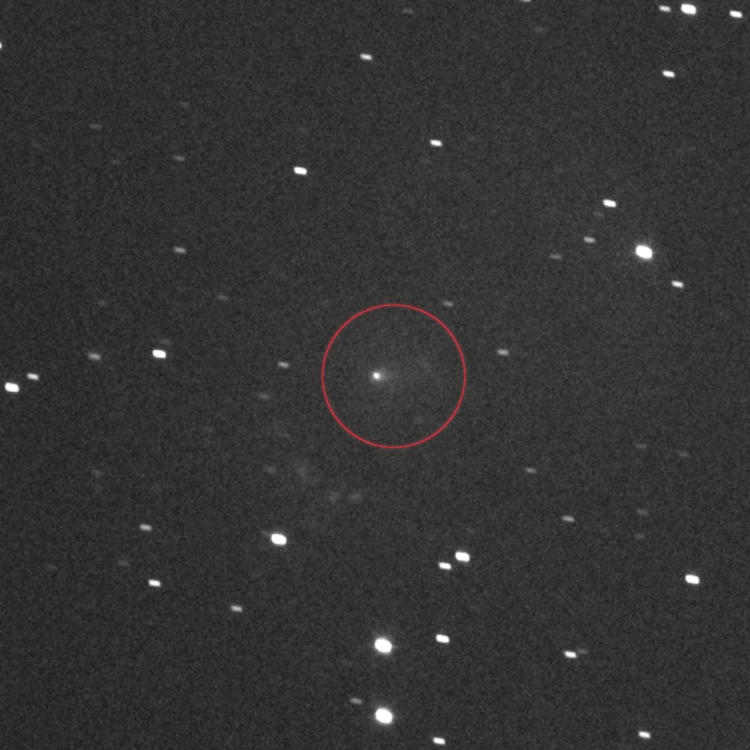
(Photo: NASA/Goddard/SwRI/JHU-APL)
The interstellar comet 3I/ATLAS is entering its closest approach to Earth in mid-December, drawing intense scientific interest as astronomers examine a rare object formed in another star system. NASA confirmed that the comet, discovered in July by the Asteroid Terrestrial-impact Last Alert System in Chile, is the third verified interstellar visitor after 'Oumuamua and 2I/Borisov. The agency described the object as "whizzing at about 137,000 mph," a speed and trajectory that confirm it is not gravitationally bound to the sun.
NASA explains that its hyperbolic orbit "confirmed to astronomers that it formed in another star system and was ejected into interstellar space - the region between the stars." The comet has likely travelled for billions of years from the direction of Sagittarius before entering the inner solar system, according to researchers who have tracked its path since the summer.
The comet will make its closest pass to Earth on Dec. 19, though scientists emphasize that it is "not a threat to Earth." Its distance at approach-about 170 million miles-is roughly twice the distance between Earth and the sun. On Oct. 30, the comet passed within 130 million miles of the sun, well inside the orbit of Mars. Scientists at the European Space Agency estimate the nucleus may be between 1,400 feet and 3.5 miles wide, based on early data from the Hubble Space Telescope.
Because of its unusual origin, the comet has become the subject of fringe speculation. Harvard astrophysicist Avi Loeb suggested publicly that the object "could be an alien spaceship," while acknowledging on Medium that it is "most likely a comet of natural origin." He added that he has not "ruled out the possibility that it could be extraterrestrial technology," a remark that fueled online conspiracies.
NASA officials rejected such theories in direct terms. Responding on social media to commentary from reality-TV personality Kim Kardashian, NASA Acting Administrator Sean Duffy wrote: "No aliens. No threat to life here on Earth." At a November news conference, Nicola Fox, associate administrator of the agency's Science Mission Directorate, said the object shows no indication of artificial origin. "We certainly haven't seen any technosignatures or anything from it that would lead us to believe it was anything other than a comet," she stated.
The agency has released new imagery of the comet from a suite of space-based instruments, including data posted Nov. 19. NASA also added 3I/ATLAS to its "Eyes on the Solar System" interactive platform, allowing the public to follow its real-time location and orbital path through spring 2026.
Astronomers say the view will require a telescope. The comet is too faint for the naked eye, and observers hoping to track it must look toward the pre-dawn sky, where it will remain visible for several months. Its brief presence offers a rare opportunity to observe material likely ejected from a planetary system that formed around a distant star.