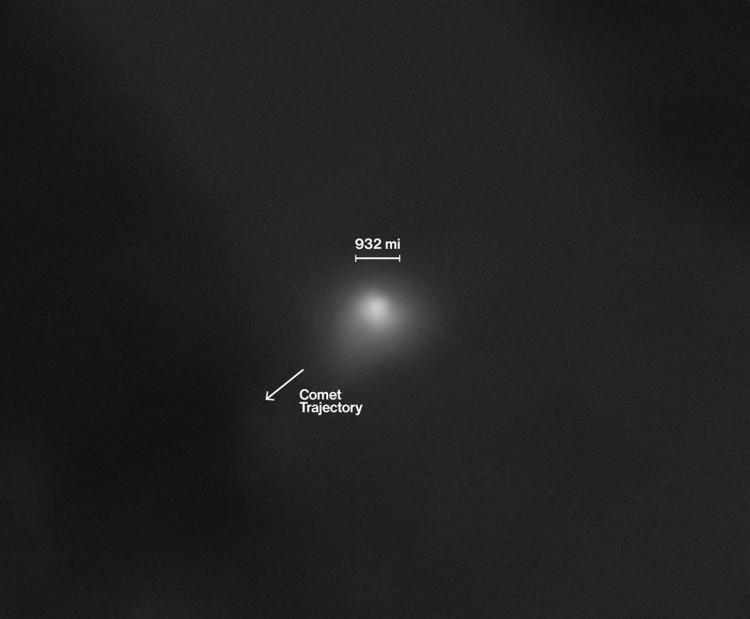
(Photo: NASA/JPL-Caltech/University of Arizona)
NASA's newly released images of the interstellar object 3I/ATLAS have intensified scientific interest in the rare visitor, even as online speculation attempts to cast doubt on its natural origins. The photographs, published in early October and captured by multiple spacecraft-including the Mars Reconnaissance Orbiter, Lucy and Psyche-show a diffuse halo, trailing dust and gas emissions characteristic of active comets approaching the Sun. NASA has reiterated that 3I/ATLAS, only the third confirmed interstellar object ever observed, aligns fully with known cometary behaviour.
The clearest view was recorded on October 2 by the Mars Reconnaissance Orbiter's HiRISE camera from roughly 0.2 astronomical units, or 30 million kilometres. The image depicts a faint nucleus enveloped by a coma and a thin, trailing tail extending away from the Sun, features NASA describes as typical for cometary bodies heating as they move inward. Observations from Lucy and Psyche have shown identical patterns, including gas emissions, dust jets and plumes driven by solar activity.
The scientific consensus contrasts sharply with theories circulating online. A small but vocal set of social media users has suggested the imagery might contain signs of artificial construction, while others claim the comet is "targeting" or clearing meteors along its trajectory. NASA's data does not support such interpretations, and astronomers emphasize that comets lack mechanisms to redirect or intercept objects in space.
Speculation gained momentum after astrophysicist Avi Loeb wrote a blog post questioning whether brightness patterns in early images matched typical comet behaviour. His post, later amplified by tabloid outlets including the New York Post, raised the idea that forward illumination could be interpreted by some as unusual. Astronomers counter that these effects emerge routinely from observational angle, dust properties and background light interference.
Scientists directly involved in the analysis say the object's physical properties-coma formation, tail orientation, dust behaviour and heating-driven activity-conform to expectations for an interstellar comet composed of ice, dust and rock. They also stress that image clarity at long distances naturally produces ambiguous contours that non-specialists may misinterpret.
3I/ATLAS has drawn heavy attention partly because of its rarity. Since the discovery of interstellar objects 1I/'Oumuamua in 2017 and 2I/Borisov in 2019, astronomers have sought additional opportunities to study material originating beyond the solar system. The current object offers a chance to examine how planetary systems form around other stars and how such bodies evolve as they pass through diverse gravitational fields.
NASA notes that while 3I/ATLAS's interstellar origin makes it scientifically valuable, nothing in its observed structure or behaviour suggests artificial design. The agency's continued monitoring will track changes in activity as the comet moves farther from the Sun, but researchers say the existing evidence overwhelmingly supports its classification as a natural object.