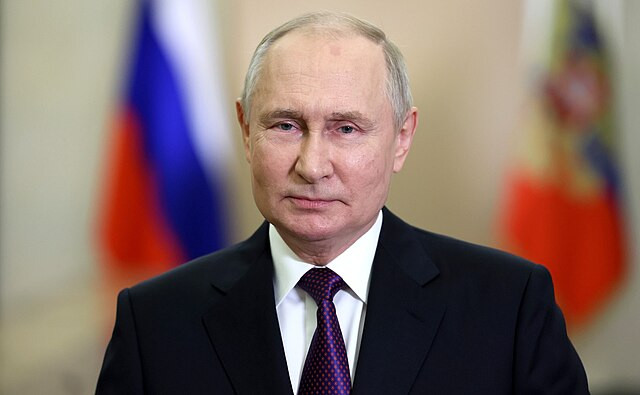
Russia's announcement that it successfully activated the nuclear propulsion system of its Poseidon underwater drone has intensified geopolitical tensions and revived debates over the future of strategic deterrence. President Vladimir Putin declared on Oct. 29, 2025, that the torpedo-described as both nuclear-powered and nuclear-armed-had been launched from a submarine and travelled under autonomous control, claiming there is "nothing like this, nothing able to intercept it."
The Kremlin's disclosure immediately reverberated through Western defence circles. Moscow characterized the test as a milestone in Russia's long-term plan to field unconventional nuclear systems capable of bypassing U.S. and NATO missile defences. Analysts said the announcement suggests Russia is moving Poseidon from concept to potential operational capability, raising concerns that the undersea domain may soon become a central arena in strategic competition.
Poseidon, known within NATO as "Kanyon," is believed to measure roughly 20 meters in length and weigh up to 100 tonnes. Russian state sources describe it as an unmanned underwater vehicle powered by a compact nuclear reactor, enabling extended transoceanic travel at depths up to 1,000 meters. Its warhead is estimated by outside experts to carry a multi-megaton yield, widely believed to be near two megatons, though Russia has never confirmed specifications.
Putin hailed the October test as a "huge success," arguing that the system represents a class of strategic weapons engineered specifically to evade traditional missile tracking architecture. Russian media, amplifying government messaging, promoted the idea that Poseidon could trigger a "radioactive tsunami," imagery that has contributed to public alarm despite skepticism from Western scientists.
Nuclear experts caution that while Poseidon's reveal marks a significant technological development, many catastrophic claims lack empirical foundation. The physics of underwater nuclear detonations suggest that blast energy disperses outward rather than channeling into massive walls of water. Analysts acknowledge that a near-shore explosion could devastate ports, naval bases and coastal infrastructure, but they widely dispute apocalyptic predictions involving continent-scale flooding.
Defence strategists, however, view the emerging system as a meaningful challenge to established arms-control frameworks. Poseidon operates in domains largely unregulated by existing treaties, which historically focused on land-based missiles, bombers and submarine-launched ballistic systems. The drone's nuclear propulsion, deep-diving capabilities and autonomous navigation could compel adversaries to upgrade underwater detection networks, straining defence budgets.
U.S. officials note that Russia has been constructing specialized submarines to carry multiple Poseidon drones, signaling an intention to integrate the system into active naval deployments. The test follows Russia's reported demonstration of a separate nuclear-powered cruise missile earlier this year, a sequence that suggests rapid diversification of Russia's strategic arsenal.
Within NATO, military planners view the announcement as part of Moscow's broader attempt to unsettle Western security assumptions. The emphasis placed by Russian officials on the drone's purported invulnerability-combined with Putin's assertion that "there is nothing like this in the world"-is interpreted as both strategic signaling and domestic political messaging.