Chinese-Canadian academic Xueqin Jiang, a history lecturer at Moonshot Academy in Beijing, has predicted that the United States will ultimately lose its war with Iran, warning that the conflict could reshape the global balance of power if it escalates further.
Jiang, who has built a large online following through his YouTube channel "Predictive History" and appearances on international podcasts, reiterated the forecast during a recent interview on the U.S. podcast "Breaking Points." His comments come as the United States and Israel continue large-scale strikes on Iranian military infrastructure under the campaign known as Operation Epic Fury, launched on Feb. 28, 2026.
The conflict has already triggered retaliatory Iranian missile attacks across the Middle East and heightened tensions in global energy markets, particularly around the Strait of Hormuz, a vital shipping route for oil and gas exports.
Jiang, whose lectures circulate widely online, originally outlined his predictions during a May 2024 talk recorded at his school and later posted to YouTube. The lecture gained attention after two of the three predictions he described later appeared to materialize.
Those forecasts included:
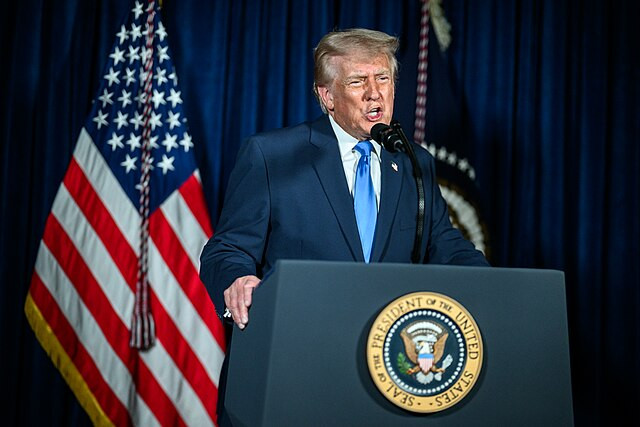
- Donald Trump's re-election in 2024, which led to his return to the White House in January 2025
- A second-term confrontation with Iran, triggered in part by regional security dynamics involving Israel
The third prediction, Jiang says, concerns the eventual outcome of the conflict itself.
"The third big prediction is that the United States will lose this war, which will forever change the global order," Jiang said in the original 2024 lecture.
Speaking on Breaking Points on March 2, Jiang repeated his view that Iran holds strategic advantages in a prolonged conflict with the United States.
"Iran has many more advantages over the United States... They've been preparing 20 years for this conflict," Jiang said.
His analysis focuses on what he describes as the structural dynamics of modern warfare in the Middle East. According to Jiang, Iran's geography, population size and regional network of allied groups could allow it to sustain a long war even under heavy aerial bombardment.
He argues that the United States would face major challenges if the conflict expanded into a ground campaign.
"We've never had a president regime change from the air alone. You need ground troops," Jiang said on the podcast.
The professor frequently frames his geopolitical predictions using historical analogies. In previous lectures, he compared a potential U.S. invasion of Iran to the Sicilian Expedition of 415 BC, when Athens attempted a massive military campaign against Syracuse during the Peloponnesian War.
Jiang argues that the episode illustrates how powerful states can overextend themselves in distant conflicts.
The war's economic impact has already drawn global attention. Rising oil prices and disruptions to shipping routes have underscored the vulnerability of energy markets during military crises in the Persian Gulf.
Jiang suggested that Iran's strategy may extend beyond military retaliation to economic disruption.
"What the Iranians are doing is waging war against the entire global economy," Jiang said.
He argued that attacks on infrastructure and threats to maritime traffic could create ripple effects across international supply chains, particularly for energy exports from Gulf states.
The academic's predictions have gained traction on social media platforms, where clips of his lectures have accumulated millions of views. His YouTube channel Predictive History has nearly two million subscribers, reflecting growing public interest in geopolitical commentary that blends historical analysis with forecasting.
At the same time, some analysts remain skeptical of predictions that frame complex conflicts in deterministic terms. Jiang's work has occasionally drawn criticism for incorporating speculative historical frameworks and references to grand geopolitical patterns.