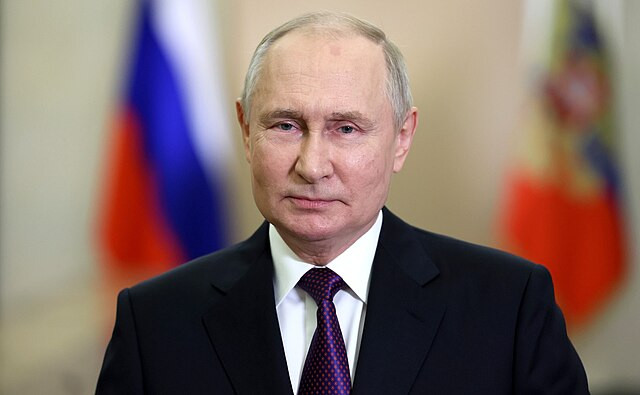
Vladimir Putin will preside over a scaled-down Victory Day parade in Moscow's Red Square on May 9, with Russia's Defense Ministry confirming that no military hardware will be displayed, marking a sharp departure from one of the Kremlin's most prominent annual demonstrations of military power.
The decision, announced by the Russian Ministry of Defense, comes as Russia faces sustained battlefield pressure in Ukraine and an expanding campaign of long-range drone strikes attributed to Volodymyr Zelenskyy's government. The parade, typically featuring tanks, missile systems and advanced weaponry, will instead be limited largely to marching troops and aerial displays.
In a statement, the ministry said: "Due to the current operational situation, students from Suvorov Military Schools and Nakhimov Naval Schools, as well as the cadet corps, and a column of military equipment will not participate in this year's military parade." The explanation leaves open interpretation but signals a significant recalibration of a core symbolic event.
Kremlin spokesman Dmitry Peskov framed the decision in security terms, citing what he described as escalating threats. "We're talking about the operational situation," Peskov said. "The Kyiv regime, which is losing ground on the battlefield every day, has now launched a full-scale terrorist attack. And so, against the backdrop of this terrorist threat, of course, all measures are being taken to minimize the danger."
The shift marks the first time in nearly two decades that armored vehicles and missile systems will not roll through Red Square, according to analysts. Military bloggers and independent observers have suggested the absence reflects concern that Ukrainian drone strikes could target equipment during rehearsals or the parade itself.
Independent analyst Ruslan Leviev told TV Rain: "Equipment is vulnerable even during the preparation stage, as columns park and rehearse outside Moscow on open training grounds that are easy to hit with drones." He added that striking targets within central Moscow would be more complex, underscoring the asymmetric risks facing Russian planners.
Victory Day, commemorating the Soviet Union's defeat of Nazi Germany, has become a cornerstone of Putin's political narrative. Over more than two decades in power, he has used the event to project military strength and national unity, particularly following Russia's full-scale invasion of Ukraine in 2022.
Recent years have already seen signs of contraction. The 2022 and 2023 parades canceled traditional aerial flyovers, while the 2024 event featured only a single World War II-era T-34 tank. Last year's 80th anniversary temporarily reversed that trend, with a full display of military hardware and attendance by foreign leaders including Xi Jinping.
This year's pared-down format arrives amid mounting economic and operational strain. Central Bank Governor Elvira Nabiullina warned this week: "Never before in the history of modern Russia have we experienced such a labor shortage." She added, "We've never had anything like this, and this is having an impact on the entire economic situation."
The pressures extend beyond manpower. Ukrainian strikes have repeatedly targeted Russian oil infrastructure, including facilities near the Black Sea, highlighting vulnerabilities in critical sectors. While elevated global oil prices have cushioned state revenues, disruptions to refining capacity have drawn attention to the war's domestic impact.
Despite the scaled-back ground display, the Kremlin plans to retain some traditional elements. Aerobatic teams are expected to fly over Red Square, with Su-25 aircraft painting the Russian tricolor in the sky, preserving a visual centerpiece of the celebration.
Putin has long defended the parade as a signal of strength. In 2008, he said: "This isn't saber-rattling: we're not threatening anyone, we don't intend to, we're not forcing anything on anyone - we have plenty of everything." He added, "This is a demonstration of our growing defense capabilities."