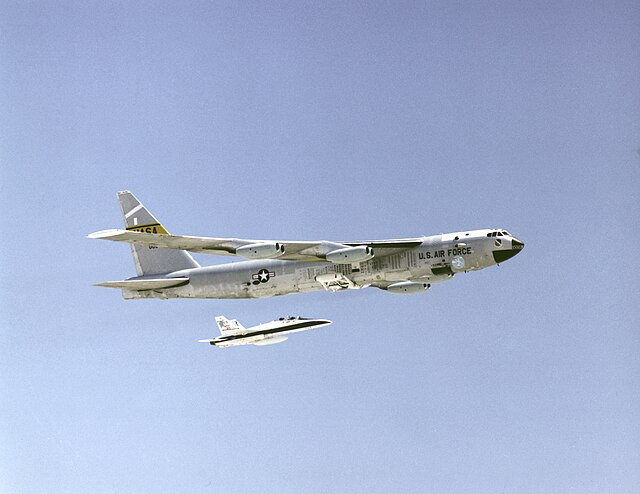
The United States and Japan conducted a high-visibility military exercise over the Sea of Japan this week, deploying U.S. B-52H strategic bombers and Japanese F-35 and F-15 fighter jets in a coordinated show of force days after China and Russia carried out joint air and naval drills near Japanese and South Korean territory. Japan's Defense Ministry said the bilateral flight reaffirmed the allies' determination "to prevent any unilateral attempt to change the status quo by force" as tensions deepen across the Indo-Pacific.
Tokyo confirmed that two U.S. B-52 bombers flew alongside three Japan Air Self-Defense Force F-35s and three F-15s on Wednesday, marking Washington's first bomber assertion over the area since Beijing began large-scale exercises last week. The drill followed a joint Chinese-Russian bomber patrol over the East China Sea and western Pacific on Tuesday, an operation Japan's top military officer said was aimed directly at Tokyo.
General Hiroaki Uchikura, Chief of Staff of the Joint Staff, said the Chinese-Russian sortie was intended as a message. "We consider it a grave concern from the standpoint of Japan's security," he told reporters, underscoring Japan's anxiety over intensifying coordination between Beijing and Moscow.
The bomber flight came as Japanese jets scrambled in response to an incident Tokyo said involved Chinese carrier aircraft locking radar onto Japanese fighters. While Japan said the episode reflected growing operational risks, China disputed the account. Foreign Ministry spokesperson Guo Jiakun said Japan had "no need to make a fuss about nothing or to take this personally," describing the drills with Russia as part of an annual cooperation plan demonstrating their shared intention to "safeguard regional peace and stability."
Washington rejected Beijing's view and criticized the Chinese actions as "not conducive to regional peace and stability," reaffirming that the U.S.-Japan alliance remains "unwavering." The Pacific Air Forces, in a separate statement, said, "Training together reaffirms our commitment to the U.S.-Japan Alliance and strengthens deterrence to ensure a free and open Indo-Pacific."
Regional security concerns expanded beyond Japan this week. South Korea scrambled fighter jets on Tuesday after the Chinese-Russian formation entered its air defense identification zone. Taiwan also reported a surge in Chinese activity, detecting 27 military aircraft-including nuclear-capable H-6K bombers-conducting "joint combat readiness patrol" operations, accompanied by naval deployments around the island for a second straight day.
Taiwan's military said J-16 fighters and H-6 bombers continued long-range training into the Western Pacific late Wednesday, passing south of the island before proceeding east. Beijing's operations come as its pressure campaign around Taiwan shows no sign of easing, and as political tensions with Japan increase following remarks by Japanese Prime Minister Sanae Takaichi about potential responses to a hypothetical Chinese attack on Taiwan.
The joint bomber drill also coincides with increased U.S. naval presence in the western Pacific. The USS George Washington aircraft carrier returned to Yokosuka, Japan, on Thursday, while the USS Abraham Lincoln arrived in Guam in the same period. Rear Admiral Todd Whalen, commander of the Abraham Lincoln strike group, said, "Our Strike Group presence in 7th Fleet waters demonstrates our commitment to a free and open Indo-Pacific," emphasizing that forward deployments strengthen readiness.
Japan remains home to roughly 60,000 U.S. military personnel, the largest concentration of American forces overseas. The combined U.S.-Japan posture-air, naval, and missile-defense assets-forms the core of the alliance's deterrence strategy as Tokyo warns of "the most severe and complex security environment" since World War II.