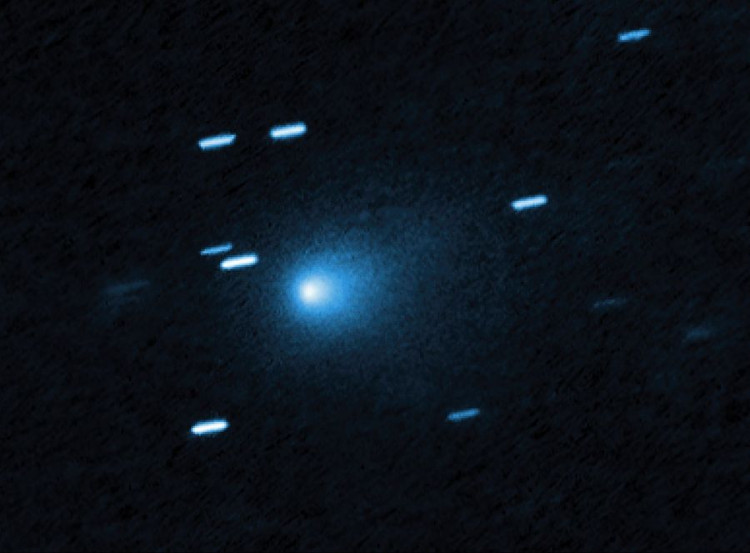
(Photo: NASA, ESA, David Jewitt (UCLA); Image Processing: Joseph DePasquale (STScI))
An interstellar comet racing through the inner solar system is giving scientists a rare chemical snapshot of material formed around another star, with early findings showing an unexpectedly low water content and a high concentration of carbon dioxide. The object, known as 3I/ATLAS, is only the third confirmed interstellar visitor ever detected and is now approaching its closest point to Earth before continuing on a one-way exit from the solar system.
First identified by the ATLAS survey on July 1, 2025, 3I/ATLAS immediately triggered a coordinated global response involving the European Space Agency, NASA and other international partners. Orbital calculations confirmed the comet is traveling on a hyperbolic trajectory, meaning it is not gravitationally bound to the Sun and will never return, sharply limiting the time available for detailed study.
As the comet emerged from behind the Sun in early November, its activity increased, allowing astronomers to analyze gases released from its nucleus. Observations from ground-based observatories and space telescopes show a chemical profile that differs markedly from comets formed in the solar system. Data indicate a composition rich in carbon dioxide ice but unusually depleted in water ice, a ratio that suggests formation in a colder, more distant region of its original star system.
Researchers also detected atomic nickel vapor in the comet's coma, a metallic component that has rarely been observed in comets and adds to the object's scientific intrigue. Together, these findings point to a body that preserves primordial material largely unaltered since its formation billions of years ago, offering a direct sample of the building blocks of an alien planetary environment.
The observational campaign has drawn on an unusually broad range of assets. ESA's XMM-Newton observatory, Japan's XRISM mission, and the James Webb Space Telescope have been used to probe the comet's gas emissions, while NASA's Hubble Space Telescope captured high-resolution images in late November using its Wide Field Camera 3. Additional data were collected opportunistically as the comet passed near Mars, with ESA repurposing instruments on Mars Express, the ExoMars Trace Gas Orbiter and the Jupiter Icy Moons Explorer to extend coverage.
Key orbital milestones now approaching include:
- Closest approach to Earth: Dec. 19, 2025
- Distance at closest approach: about 269 million kilometers (167 million miles)
- Projected crossing of Jupiter's orbit: spring 2026
Despite its large size and near-ecliptic path, both consistent with known comet behavior, 3I/ATLAS is traveling at extreme speed and is already accelerating out of the solar system. Scientists expect it to fade beyond the effective range of major observatories by the end of the decade.
Interstellar objects like 3I/ATLAS are scientifically valuable precisely because they do not originate around the Sun. By comparing their chemistry with that of native comets, researchers hope to refine models of how planetary systems form and evolve across the galaxy. The carbon-heavy, water-poor profile seen so far is challenging assumptions based largely on solar-system examples and suggests a wider diversity of comet formation environments than previously understood.