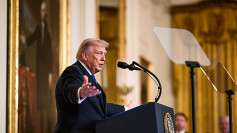
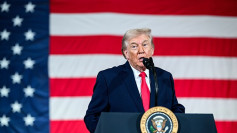
President Donald Trump used a White House Hanukkah celebration this week to deliver a pointed political warning about what he described as rising antisemitism in Congress, even as he disclosed sharply higher costs for a controversial plan to build a new $400 million ballroom on White House grounds. The remarks, delivered during a religious event traditionally marked by bipartisan symbolism, immediately reignited debate over Trump's rhetoric, his approach to Israel, and the limits of presidential authority over historic federal property.
Speaking before invited guests on Tuesday night, Trump framed himself as a defender of Israel and the Jewish community while arguing that their political influence in Washington has waned. "I will always be a friend and a champion to the Jewish people," Trump said. "If you go back 10, 12, 15 years ago, at the most, the strongest lobby in Washington was the Jewish Lobby. It was Israel. That's no longer true."
Trump then singled out several Democratic lawmakers, warning of what he called a broader shift in congressional attitudes. "You have to be very careful. You have a Congress in particular, which is becoming antisemitic. You have AOC plus three. You have those people," he said, later adding that Rep. Ilhan Omar "hates Jewish people." He also said, "And you have to be very careful, because there's been a big change."
The president tied his remarks to recent acts of violence against Jewish communities, citing the Oct. 7, 2023, Hamas attack in Israel and a deadly assault at a Jewish gathering in Bondi Beach, Australia. His comments drew immediate criticism from political opponents, who questioned both the substance and setting of the accusations.
Alongside the political messaging, Trump revealed new details about a White House construction project that has become increasingly contentious. He said the cost of a proposed ballroom has now reached $400 million, up from earlier estimates of $130 million and later $300 million. The project would replace the East Wing with a modernized structure and add a large ballroom designed for state functions.
Describing the planned building, Trump said the ballroom would feature heavy security enhancements. "Now I will say, if I'm up making the speech some day and I hear ding, ding, ding, I'm out of there," he said. "I think it'll be the greatest ballroom anywhere in the world." He also claimed the structure would include "five-inch-thick glass," adding that it would be "impenetrable, except for a howitzer."
The proposal has drawn strong opposition from preservation and cultural groups. A report prepared by the National Park Service, authored by Deputy Director Frank Land and signed by Acting Director Jessica Bowron, warned that demolishing the East Wing would have adverse effects on the historic character of the White House complex, even as it acknowledged potential gains in functionality and visitor access. The plan would expand the complex by roughly 90,000 square feet and could be completed by 2028.
The National Trust for Historic Preservation has called for formal review and public consultation, arguing that no president has unilateral authority to demolish or substantially alter portions of the White House without oversight. Legal challenges have raised questions about whether the project complies with federal preservation laws governing historic landmarks on government land.