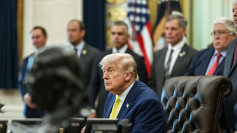
President Donald Trump sharply rebuked a reporter in the Oval Office this week when asked how his administration would address concerns from survivors of Jeffrey Epstein's sex-trafficking network, underscoring the political volatility surrounding newly released Justice Department records and lingering demands for accountability. The exchange unfolded on Feb. 3, 2026, after a bill-signing event, and quickly circulated across social media and cable news.
The confrontation began when Kaitlan Collins, chief White House correspondent for CNN, pressed the president on what he would say to survivors who believe justice remains elusive. Trump attempted to deflect, saying it was "time for the country to get on to something else," before casting renewed scrutiny of the Epstein files as politically motivated.
As Collins persisted-"These are survivors of a sexual abuser"-Trump turned his criticism toward the journalist rather than addressing the substance of the question. "You are so bad. You are the worst reporter. CNN has no ratings because of people like you," Trump said, according to footage captured by the press pool. He added that he had "never seen you smile" in the decade he has known her.
The episode landed amid heightened attention to the Department of Justice's release of more than three million pages of Epstein-related records, including witness interviews and internal communications involving prominent figures. Survivors and advocates have argued that extensive redactions obscure the scope of Epstein's network and the government's past handling of the case.
In public hearings and press conferences over the past year, survivors have urged lawmakers to compel fuller disclosure. At a widely reported event in Washington on Sept. 3, 2025, several survivors called for the release of all federal case files, saying transparency is essential to understanding how abuse persisted for years. One survivor told PBS News that the abuse was real, pushing back against suggestions by political figures that the controversy amounted to a "hoax."
Congressional efforts to expand disclosure have moved unevenly. The Epstein Transparency Act, signed into law, was intended to broaden access to Justice Department materials, though DOJ leadership has said parts of the statute do not require additional unredacted releases. The issue has since become a flashpoint on Capitol Hill, with Democrats pressing for more hearings and some Republicans resisting further action.
The political backdrop has grown more complex with plans for testimony by Bill Clinton and Hillary Clinton, both of whom have faced scrutiny over historical ties to Epstein's social circle. House committees have framed the inquiry as an effort to establish a complete public record rather than reopen closed criminal cases.
Trump has repeatedly characterized renewed attention to Epstein-related documents as partisan, labeling the controversy a "Democrat hoax" following survivor demonstrations last year. His Oval Office exchange this week reflected that stance, as he declined to address survivors' concerns directly while assailing the messenger.