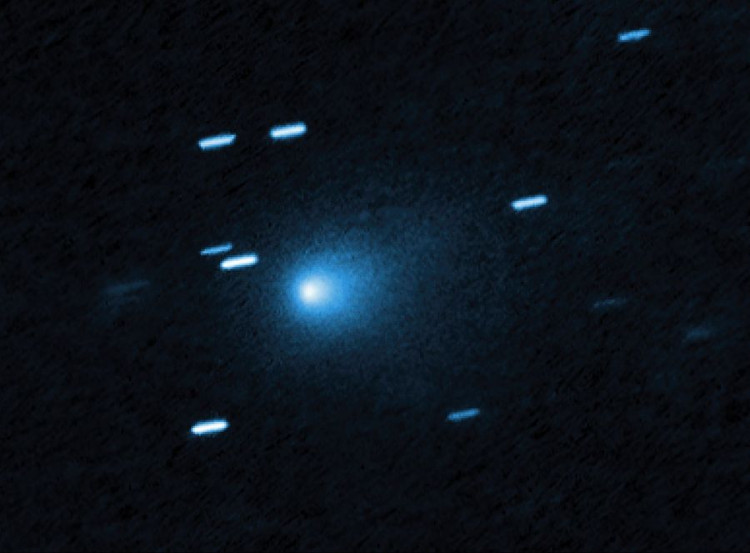
(Photo: NASA, ESA, David Jewitt (UCLA); Image Processing: Joseph DePasquale (STScI))
NASA is tracking a rare interstellar object known as 3I/ATLAS as it approaches its closest point to Earth on Friday, offering scientists a fleeting opportunity to study material formed around another star system while tamping down online speculation about its origins. The object, discovered earlier this year by a Chile-based telescope in a NASA-funded survey network, will pass safely at a distance of about 170 million miles, according to agency data.
Designated 3I/ATLAS, the object is only the third confirmed visitor from outside the solar system, following 1I/'Oumuamua in 2017 and 2I/Borisov in 2019. Unlike comets bound to the sun, its hyperbolic trajectory shows it is not gravitationally tied to the solar system and will leave permanently after its brief passage.
NASA says the object was detected by the Asteroid Terrestrial-impact Last Alert System, part of a global effort designed to identify near-Earth objects early. Although its discovery quickly attracted attention online, agency scientists emphasize that 3I/ATLAS poses no threat to Earth and is behaving consistently with a natural comet composed of rock, dust and volatile ice.
The rarity of interstellar visitors has amplified public fascination. In recent weeks, social media posts have circulated claims that the object could be artificial in origin. Astronomers have rejected those assertions, noting that its motion, reflectivity and evolving tail are consistent with known cometary physics rather than propulsion or controlled flight.
Through most amateur telescopes, 3I/ATLAS appears as a faint, diffuse point of light moving slowly against the background stars of the Virgo constellation. Long-exposure images taken by professional observatories show a distorted tail shaped by solar radiation and the solar wind, but otherwise reveal few dramatic changes as it travels inward and back out again.
On Dec. 19, the object will reach its closest approach to Earth at roughly 1.8 astronomical units. That distance places it well beyond the orbit of Mars and nearly twice as far away as the sun. NASA scientists say this scale often surprises the public, as even "close" encounters in astronomical terms still span hundreds of millions of miles.
Despite the proximity by cosmic standards, space agencies lack the ability to capture detailed, close-up images of such a small, dark object at that range. Observations during the fly-by will rely on ground-based telescopes and spectral analysis to determine composition rather than surface detail.
Researchers are focusing on how 3I/ATLAS compares chemically to native solar system comets. By analyzing light reflected and emitted by its coma and tail, scientists hope to learn whether planetary systems elsewhere produce similar materials or follow different formation paths.