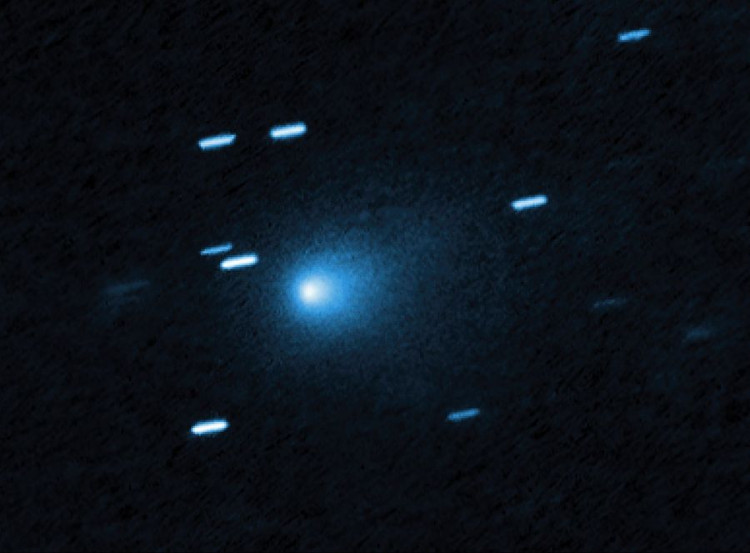
(Photo: NASA, ESA, David Jewitt (UCLA); Image Processing: Joseph DePasquale (STScI))
Astronomers analyzing the interstellar object known as 3I/ATLAS say new trajectory and composition data point to an origin deep within the Milky Way's central region, an environment marked by intense radiation, dense stellar traffic and extreme gravitational forces. The object, discovered on July 1, 2025, by the ATLAS survey in Río Hurtado, Chile, is now understood to have entered the solar system from the direction of the Sagittarius constellation, a corridor that aligns with the galaxy's turbulent core roughly 26,000 light-years away.
Researchers say that origin alone helps explain why 3I/ATLAS behaves unlike most comets observed in the solar system. Traveling on a hyperbolic path at roughly 58 kilometers per second, or about 130,000 miles per hour, the object is moving too fast to be gravitationally bound to the Sun, confirming it as interstellar in nature. Its trajectory suggests it was ejected from a high-energy environment long before encountering Earth's neighborhood.
Data from the Hubble Space Telescope have added detail to that picture. Observations taken in mid-December show a compact nucleus estimated to measure between roughly 440 meters and 3.5 miles across, accompanied by persistent jet activity that does not conform to standard comet behavior. Scientists analyzing the images reported asymmetric structures and a sunward-facing "anti-tail," features that are rare among objects formed in calmer stellar regions.
The direction of origin is central to understanding those anomalies. The Sagittarius region points toward the Milky Way's dense core, where stellar densities are thousands of times higher than in the Sun's vicinity. Objects formed or ejected there are exposed to supernova shockwaves, intense ultraviolet radiation and close gravitational encounters, conditions capable of altering composition, spin and surface structure.
Researchers, including Harvard astrophysicist Avi Loeb, have emphasized that bodies arriving from such environments should not be expected to resemble familiar comets or asteroids. NASA and the Jet Propulsion Laboratory have similarly noted that an object's birthplace is essential for interpreting its physical behavior, particularly when it displays persistent non-gravitational acceleration.
Observations indicate that 3I/ATLAS exhibits complex jet activity and rotational behavior that appear misaligned with simple solar-heating models. High-resolution imaging shows structures that remain stable over time, suggesting internal characteristics shaped long before the object entered the solar system. Analysts also point to chemical signatures indicating elevated levels of carbon-bearing compounds and metallic elements rarely dominant in local comet populations.
Key measured characteristics include:
- Hyperbolic excess velocity of approximately 58 km/s
- Closest Earth approach of about 168 million miles on Dec. 19
- Nucleus diameter estimated between 0.4 and 5.6 kilometers
- Persistent jet and anti-tail structures visible across multiple observations
Astronomers note that such properties are consistent with material forged or processed in high-radiation zones near the galactic center. In those regions, objects can be reshaped by repeated stellar encounters or expelled at high speeds during gravitational interactions, leaving long-lasting structural signatures.
The object's path through Sagittarius also carries symbolic weight for researchers, as the constellation visually points toward the Milky Way's core. Its emergence from that direction reinforces models suggesting that interstellar visitors may frequently originate in dense stellar hubs rather than in quieter spiral-arm environments like the Sun's neighborhood.
From a planetary-defense perspective, scientists say 3I/ATLAS highlights how little is known about fast-moving interstellar bodies. Objects arriving from the galactic center may travel faster, appear with little warning and display physical properties that challenge detection and modeling systems designed around familiar solar-system debris.