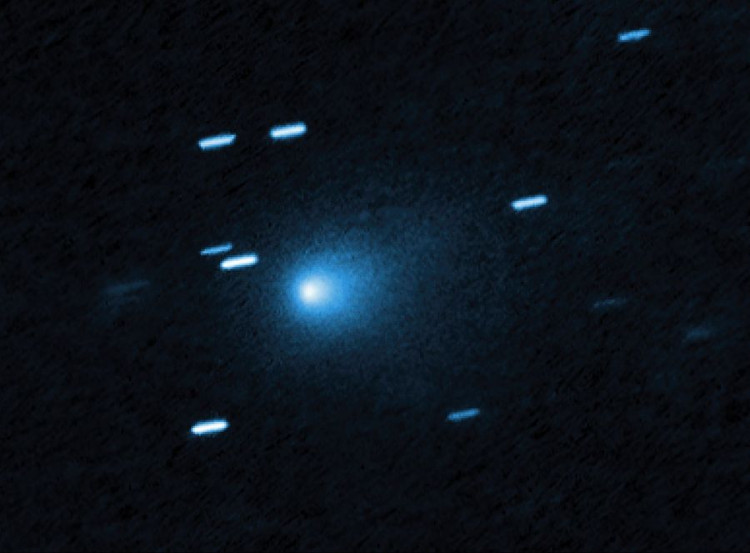
(Photo: NASA, ESA, David Jewitt (UCLA); Image Processing: Joseph DePasquale (STScI))
An interstellar object detected last summer has ignited a renewed debate among astronomers after researchers floated the possibility that it may have formed near the dawn of the Milky Way, challenging assumptions about how ancient material can survive intact in interstellar space. The object, designated 3I/ATLAS, was first observed on July 1, 2025, by the Asteroid Terrestrial-impact Last Alert System operating from Chile.
Initial tracking identified the body as a near-Earth object, but orbital calculations quickly confirmed a hyperbolic trajectory inconsistent with any origin inside the solar system. Follow-up analysis established that 3I/ATLAS was moving fast enough to escape solar gravity, placing it among a rare class of confirmed interstellar visitors previously limited to 1I/'Oumuamua and 2I/Borisov.
The controversy intensified after Michele Bannister and colleagues at the University of Canterbury proposed that the object may have originated in the Milky Way's thick disk. That region contains some of the galaxy's oldest stars, formed shortly after the Big Bang, leading to speculation that the object could be significantly older than the Sun.
Researchers caution, however, that age estimates derived from orbital modeling are inherently indirect. Without a physical sample, scientists must infer history from velocity, trajectory and stellar population statistics rather than isotopic measurements. Dating an object solely through motion places firm limits on certainty, especially for bodies that have spent billions of years drifting through interstellar space.
More conservative assessments from NASA indicate that despite its unusual trajectory, 3I/ATLAS shares behavioral characteristics with long-period comets. That would place its formation closer to the roughly 4.5-billion-year age typical of material originating during planetary system formation.
What has drawn broad agreement is that the object's composition differs markedly from solar-system bodies. Observations from the James Webb Space Telescope revealed an unusually high carbon-dioxide-to-water ratio, among the highest recorded for a comet-like object. The chemical signature reinforced the conclusion that the object formed under conditions distinct from those surrounding the Sun.
Additional measurements from the Very Large Telescope detected atomic nickel and iron vapor in the coma at distances from the Sun where such metals are typically inert. The presence of these elements at low solar heating levels has challenged existing sublimation models and prompted further scrutiny of the object's internal structure.
Ground-based observatories, including facilities in Tenerife, have documented shifting jets and non-gravitational acceleration that appear to alter the object's rotation over time. Some researchers, including Avi Loeb, have argued that the dynamics merit close examination, though most teams continue to attribute the behavior to natural processes such as nucleus precession and volatile release.
3I/ATLAS passed its closest point to Earth on December 19, 2025, at a distance of roughly 1.8 astronomical units, or about 170 million miles. By early 2026, it had faded beyond naked-eye visibility and was moving outbound through the constellation Leo, carrying with it unresolved questions about how much of the galaxy's earliest history may still be passing silently through the solar system.