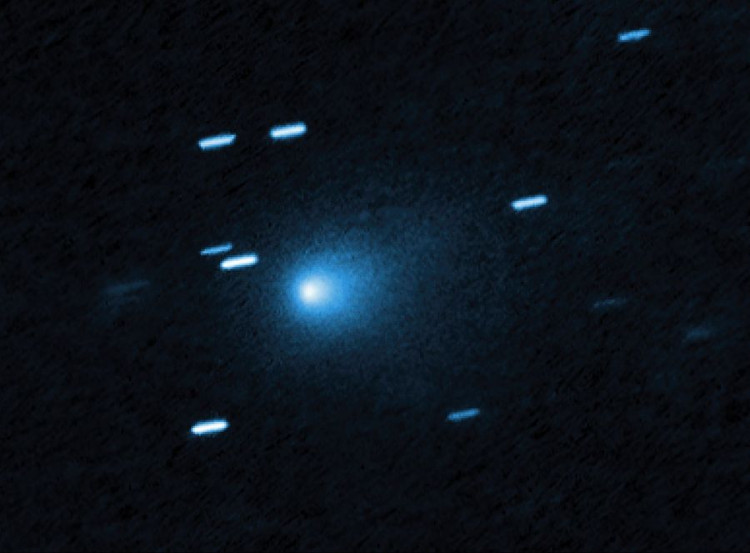
(Photo: NASA, ESA, David Jewitt (UCLA); Image Processing: Joseph DePasquale (STScI))
Astronomers at NASA and the Gemini North Observatory have released new images of 3I/ATLAS, revealing a vivid green glow that underscores the object's alien origins and fleeting passage through the Solar System. The comet, only the third confirmed interstellar visitor ever detected, is now providing scientists with rare visual and chemical clues about material formed around a distant, unknown star.
The images were captured in late November 2025 from the summit of Maunakea, where Gemini North tracked the fast-moving object as it emerged from behind the Sun. The green hue, researchers say, marks a striking change from the faint reddish tones seen earlier in the year when the comet was first observed from Chile.
The color shift reflects a fundamental transformation in the comet's activity as solar heating intensifies. As 3I/ATLAS approached the Sun, frozen material beneath its surface began to vaporize, releasing gases that fluoresce under solar radiation. Scientists attribute the emerald glow to diatomic carbon, a molecule that emits green light when energized, producing a visual signature rarely observed with such clarity.
Unlike periodic comets bound to the Sun, 3I/ATLAS is on a hyperbolic trajectory, confirming it is not gravitationally tied to the Solar System. Researchers believe it formed around another star entirely and may be among the oldest comets ever observed, offering a glimpse into chemistry predating the Sun itself.
Capturing the images required precision tracking. Because the comet moves rapidly against the stellar background, Gemini North locked onto the object itself, causing background stars to streak during long exposures. Astronomers then combined images taken through blue, green, orange, and red filters using the Gemini Multi-Object Spectrograph to produce a stabilized composite.
The data processing was handled in collaboration with NSF NOIRLab, whose team corrected for the comet's motion while preserving fine structural details in the coma. The resulting images provide both scientific insight and public visibility into how transient interstellar objects are studied.
Bryce Bolin, a research scientist at Eureka Scientific who led the observing program, said the effort helps "demystify the scientific and data collection process," emphasizing transparency in how astronomers pursue fleeting targets that may never return.
As the comet continues outbound, astronomers caution that its display may not be finished. Some comets undergo delayed outbursts as residual heat penetrates deeper layers, potentially triggering sudden releases of trapped gas even as the object recedes from the Sun.