(Photo: NASA/Goddard/SwRI/JHU-APL)
NASA scientists have confirmed new details about the interstellar comet known as 3I/ATLAS after capturing rare ultraviolet observations from the Europa Clipper spacecraft, even as a parallel search for artificial radio signals ended without detection. The findings deepen scientific understanding of the fastest interstellar object ever observed while closing the door-at least for now-on speculation about non-natural origins.
The comet, first detected on July 1, 2025, by the NASA-funded ATLAS survey in Chile, is only the third confirmed interstellar object to pass through the solar system, following 'Oumuamua in 2017 and Borisov in 2019. Traveling on a hyperbolic trajectory with a record-breaking eccentricity of 6.14, 3I/ATLAS reached a peak velocity of roughly 153,000 miles per hour as it passed through the inner solar system.
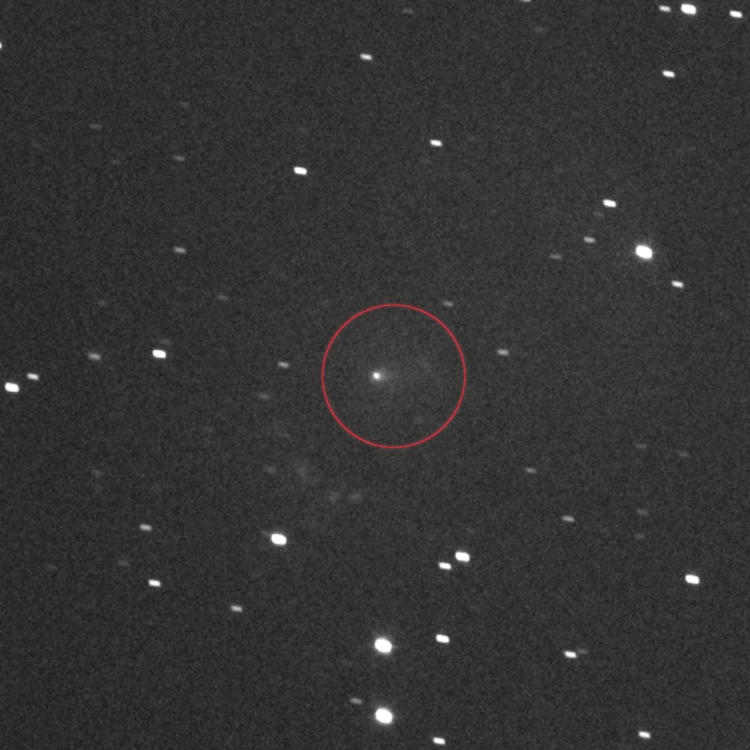
In November, Europa Clipper-en route to Jupiter-was briefly repurposed to observe the comet using its ultraviolet spectrograph, an instrument originally designed to analyze the icy surface of Europa. According to a statement released Tuesday by the SETI Institute, the spacecraft successfully imaged the comet from a "sunward" vantage point unavailable to Earth-based telescopes, despite being approximately 102 million miles away.
The ultraviolet data revealed hydrogen and oxygen emissions in the comet's coma, confirming active water-ice sublimation as solar radiation heated its surface. Those observations aligned with separate infrared measurements from the James Webb Space Telescope, which showed that the comet's volatile output is dominated by carbon dioxide, with an estimated CO₂-to-water production ratio of roughly 8:1.
The chemical profile suggests that 3I/ATLAS formed in a star system with conditions markedly different from those of the early solar system. Researchers said the data also indicate that the object remained structurally intact during its passage, showing no signs of fragmentation from thermal or gravitational stress.
NASA emphasized that the comet poses no danger to Earth. It made its closest approach on Dec. 19, 2025, passing at a distance of about 170 million miles, or 1.8 astronomical units. The object is now outbound and expected to remain observable from Earth until spring 2026 as it exits the solar system permanently.
Separately, astronomers with the Breakthrough Listen initiative trained the Green Bank Telescope on the comet one day before its closest approach, scanning radio frequencies between 1 and 12 gigahertz for potential technosignatures. The effort yielded no evidence of artificial transmissions.
"We all would have been thrilled to find technosignatures coming from 3I/ATLAS, but they're just not there," Benjamin Jacobson-Bell of the University of California, Berkeley, told Space.com after researchers ruled out nine initial signal candidates as terrestrial interference.
Additional observations were conducted by the Mars Reconnaissance Orbiter and even the Perseverance rover, which briefly paused surface operations in October to image the comet from Mars. Europe's JUICE mission also tracked the object during its transit.