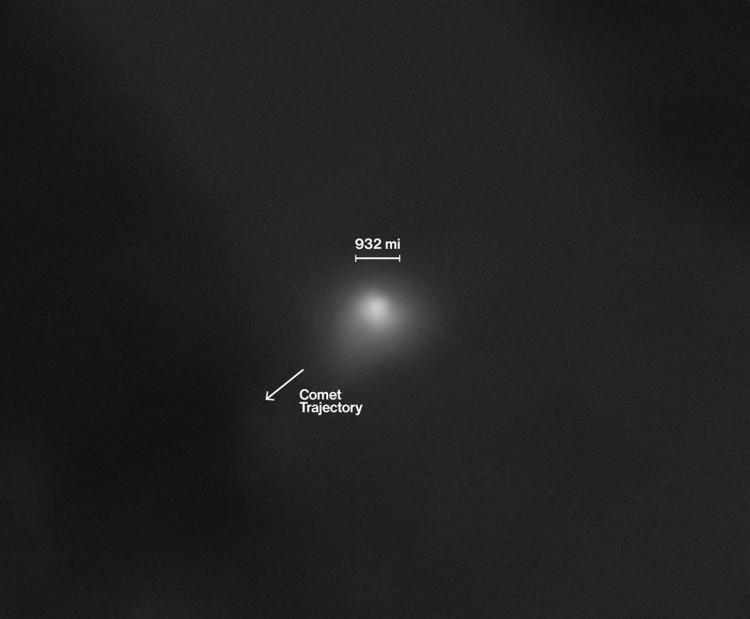
(Photo: NASA/JPL-Caltech/University of Arizona)
Scientists are reexamining long-held assumptions about interstellar objects after new observations of 3I/ATLAS, only the third confirmed visitor from beyond the solar system, revealed geometric features and motion patterns that do not fit neatly within existing comet or asteroid models.
The object was first detected on July 1, 2025, by the Asteroid Terrestrial-impact Last Alert System in Chile and later tracked by NASA and international observatories. Early data suggested a faint, fast-moving body on a hyperbolic trajectory, confirming it originated outside the Sun's gravitational influence. Subsequent high-resolution imagery, however, prompted renewed scrutiny across the astronomical community.
Researchers analyzing late-2025 observations reported strikingly symmetrical jet-like structures extending laterally from the object's nucleus, forming an apparent X-shaped configuration oriented toward the Sun. The precision and stability of this alignment stand in contrast to the irregular outgassing typically observed in comets, which tend to emit material unevenly as they rotate.
Estimates derived from observations by the Hubble Space Telescope place the nucleus between roughly 320 meters and 5.6 kilometers wide, making 3I/ATLAS substantially larger than previous interstellar visitors. Its velocity has also drawn attention: the object entered the solar system at approximately 137,000 miles per hour, peaking near 153,000 miles per hour during its closest approach to the Sun on Oct. 29, 2025.
By comparison, the first known interstellar object, ʻOumuamua, discovered in 2017, displayed unusual acceleration without a visible tail, while 2I/Borisov behaved more like a conventional comet. Astronomers say 3I/ATLAS appears to share characteristics with both, while also introducing anomalies not previously documented.
Spectroscopic analysis has further complicated interpretation. Data indicate a chemical makeup rich in carbon dioxide, alongside a nickel-to-cyanide ratio far exceeding that of any known comet. While researchers caution that observational limits and unknown formation environments could account for such readings, the findings have fueled debate over whether 3I/ATLAS represents a new class of natural interstellar object.
Among those urging broader consideration is Avi Loeb, who has argued that the object's trajectory deserves closer examination. Calculations show that 3I/ATLAS passed within tens of millions of kilometers of Mars, Venus, and Jupiter in a sequence of flybys that he has described as statistically improbable under random conditions, though other scientists note that rare alignments are expected given enough observations.
Most researchers continue to favor natural explanations, emphasizing that unfamiliar physics and chemistry may be at play in environments far removed from the solar system. Still, they acknowledge that current models are based on a sample size of three, limiting confidence in any single interpretation.
On Dec. 19, 2025, 3I/ATLAS made its closest approach to Earth at a distance of roughly 170 million miles, posing no threat. As it recedes back into interstellar space, astronomers are racing to collect additional data, viewing the object as a rare opportunity to refine theories about planetary formation, stellar debris, and the diversity of matter moving between stars.