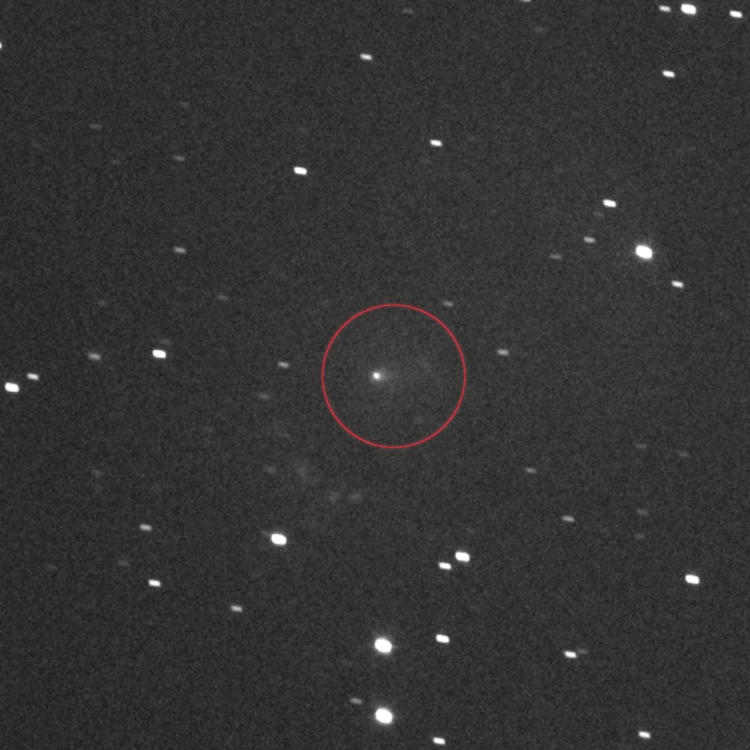
(Photo: NASA/Goddard/SwRI/JHU-APL)
Scientists at NASA are intensifying observations of a massive interstellar comet that briefly vanished behind the Sun before reappearing brighter than expected, underscoring the growing scientific interest in a visitor believed to be billions of years older than the solar system. The object, known as 3I/ATLAS, reached perihelion on Oct. 29 after a high-speed plunge toward the Sun, prompting coordinated monitoring across space- and ground-based observatories.
The comet was first detected on July 1, 2025, by astronomer Larry Denneau using the NASA-funded ATLAS survey telescope in Río Hurtado, Chile. Initially catalogued as C/2025 N1, the object was later confirmed as only the third known interstellar body ever observed passing through the solar system, following 1I/'Oumuamua and 2I/Borisov.
As 3I/ATLAS approached the Sun, its trajectory took it out of sight of Earth-based telescopes, raising questions about whether it would survive the encounter. Instead, data returned from space-based instruments suggested the comet underwent a dramatic physical transformation, including a sudden increase in brightness.
One of the earliest post-perihelion detections came from an unexpected source. On Oct. 18, Thai astronomer Worachate Boonplod identified the object in imagery from the GOES-19 weather satellite. "It's moving from left to right across the field," Boonplod wrote in a message to the Comets Mailing List, adding that the comet "should leave the CCOR-1 view soon."
Subsequent tracking by NASA's PUNCH mission and the SOHO observatory confirmed that the comet's activity was intensifying. Researchers reported that the object reached a peak brightness of roughly magnitude 9, a notable increase for an interstellar visitor still requiring telescopic observation.
Analysis from the James Webb Space Telescope revealed chemical signatures that distinguish 3I/ATLAS from comets native to the solar system. Data showed carbon dioxide outnumbering water ice by roughly eight to one, along with gas unusually rich in nickel. Scientists also observed a distinct blue hue, widely interpreted as evidence of gas-dominated emissions rather than dust.
The comet's behavior has been equally striking. Hubble observations indicated dust was initially pushed sunward before being forced back by solar radiation pressure, a reversal rarely seen in local comets. With an orbital eccentricity of about 6.14, 3I/ATLAS is traveling on a hyperbolic path that will carry it permanently out of the solar system.
Since its discovery, the object has been clocked at approximately 130,000 miles per hour. Its extreme speed and chemical composition have fueled speculation beyond the scientific community. Reality-television figure Kim Kardashian drew attention online in October when she urged NASA to "spill the tea" about the comet, while others suggested its motion warranted closer scrutiny.
NASA scientists have consistently emphasized that the evidence points to a natural origin, likely from the Milky Way's thick disk, a region populated by some of the galaxy's oldest stars. Estimates place the comet's age at up to eight billion years.
The comet made its closest approach to Earth on Dec. 19, passing at a distance of roughly 170 million miles. It is currently visible in the constellation Cancer and remains under observation as it heads toward a potential close encounter with Jupiter-orbiting spacecraft in March 2026, offering researchers another rare opportunity to study material formed long before the Sun existed.