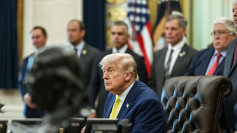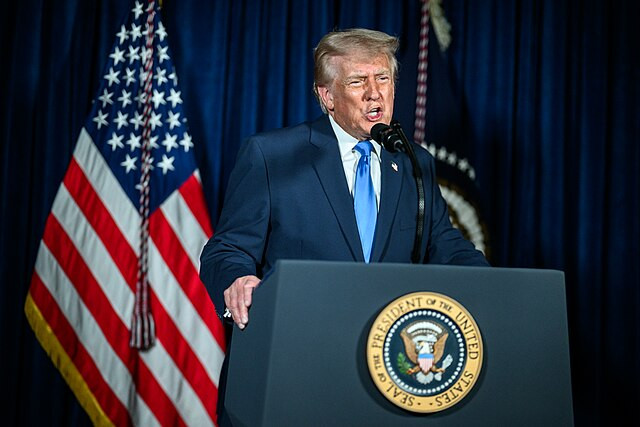
President Donald Trump used the World Economic Forum in Davos this week to harden his demand for U.S. control of Greenland, declaring the Arctic territory "imperative for national and world security" and insisting there was "no going back," a stance that triggered fresh tariff threats against European allies and unsettled markets across the Atlantic.
Speaking before meetings in the Swiss Alps, Trump said the United States "has to have" Greenland, framing the acquisition as a security necessity rather than a subject for negotiation. "Greenland is imperative for national and world security," he said, adding: "There is no going back." The comments coincided with warnings that Washington would impose 10% tariffs on goods from eight European countries if they refused to agree to the transfer.
The tariff threat-aimed at Denmark, the United Kingdom and six other European allies-would take effect at 10% initially, Trump said, rising later if no deal were reached. European officials said the move risks opening a trade war among NATO partners at a time of heightened geopolitical tension.
Trump amplified the pressure through social media, posting screenshots of what he described as private messages from European leaders and circulating AI-generated images depicting himself planting a U.S. flag on Arctic ice. The posts included a message attributed to Emmanuel Macron saying, "I do not understand what you are doing on Greenland," and another attributed to Mark Rutte expressing commitment to "finding a way forward."
The tactic drew mixed reactions from Trump allies and critics alike. Anthony Scaramucci, speaking at Davos, rejected suggestions the tariff threats were merely leverage. "I don't think this is a negotiating tactic," he said. "I think it's attention seeking. I think it's going to resolve itself." He added: "The Europeans are going to have to put some teeth into their rebuttals to President Trump. He's sending out messages in an effort to humiliate people like Rutte and Macron."
European leaders responded publicly with a show of unity. Ursula von der Leyen said Greenland's status was "non-negotiable" and called the tariff threat "a mistake, especially between long-standing allies," pledging that Europe's response would be "unflinching, united and proportional."
In London, Keir Starmer described the tariff threat as "very serious," while officials in Copenhagen reiterated that Greenland's future is a matter for the island's population and Denmark. NATO diplomats said the episode risked eroding alliance trust.
Markets reflected the strain. European equity indices fell between 1.2% and 1.5% during the week, while gold climbed to a record $4,731.34 an ounce as investors sought safety. U.S. stock futures pointed lower, and the dollar weakened against both sterling and the euro.
Trump has argued that Greenland's Arctic position is vital to counter Russian and Chinese activity, despite an existing 1951 defense agreement that already grants the U.S. broad access to the island. Russia's foreign minister denied any plot involving Greenland, undercutting one of the administration's stated rationales.