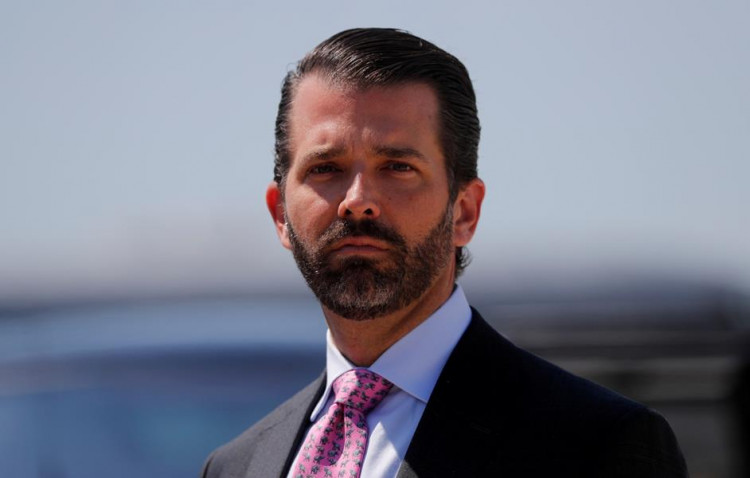
House Republicans abruptly shut down a congressional hearing and blocked a subpoena targeting Donald Trump Jr., preventing testimony over a $620 million Pentagon loan awarded to a company backed by his venture firm, intensifying a growing political battle over potential conflicts of interest within the Trump administration.
The confrontation unfolded during a House Natural Resources Subcommittee session on March 25, where Democrats sought to compel testimony from Trump Jr., Pentagon official Patrick Witt and Vulcan Elements CEO John Maslin. The hearing ended after Republicans walked out, halting debate on the subpoena.
Representative Maxine Dexter, the panel's top Democrat, framed the issue as a test of congressional oversight. "We are done waiting for Republicans to fulfil their responsibility to conduct oversight," Dexter said. "Donald Trump Jr. must be made to answer whether the President's son illegally profited from his father's presidency."
At the center of the dispute is a tightly compressed timeline linking private investment and federal funding. In August 2025, venture firm 1789 Capital-where Trump Jr. is a partner-invested in Vulcan Elements as part of a $65 million funding round. Three months later, the Department of Defense awarded Vulcan a $620 million loan through its Office of Strategic Capital.
Additional federal support brought the total public funding tied to the company to more than £524 million ($670 million), including equity from the Department of Commerce. The loan marked the largest issued by the Office of Strategic Capital, raising questions about process and oversight.
Democrats highlighted concerns about how the funding was approved:
- Loan size exceeded twice Vulcan's valuation at the time of investment
- Award reportedly issued without competitive procurement
- Technical review requirements were waived under Executive Order 14241
The Pentagon has denied any improper involvement by Trump Jr. A spokesperson said he "was not involved in any aspect of the conditional loan commitment discussions between OSC and Vulcan." Executives at Vulcan Elements and other firms tied to 1789 Capital have similarly rejected claims of influence.
The controversy extends beyond a single deal. Reporting cited by lawmakers indicates that at least four companies linked to 1789 Capital received federal contracts or awards in 2025 totaling more than $735 million, suggesting a broader pattern of overlap between private investments and government funding.
Trump Jr.'s role in defense-related matters has also drawn attention. He said on his podcast that he had screened candidates for senior Pentagon roles during the transition period, favoring those supportive of increased drone spending-policy priorities later reflected in Defense Department directives.
The political dimension of the dispute has been sharpened by comparisons to prior investigations. Democrats pointed to statements by Republican leaders during earlier probes into Hunter Biden, including assertions that a president's "participation in enriching his family is, in a word, abuse of the highest order," language now being cited back against Republican leadership.