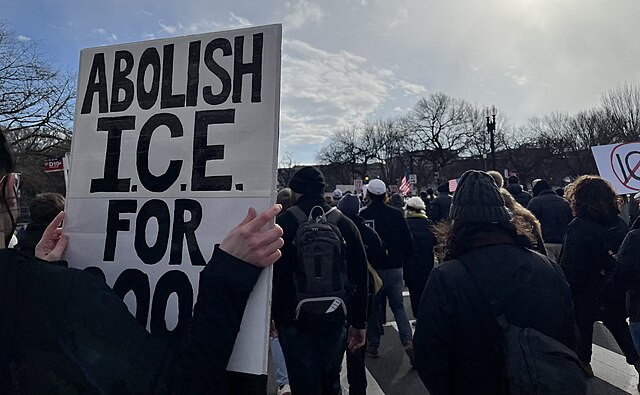
A 10-hour standoff in South Burlington involving U.S. Immigration and Customs Enforcement has triggered a sharp institutional clash after newly released body camera footage showed an ICE agent acknowledging uncertainty about the identity of the suspect at the center of the operation.
The incident, which unfolded in a residential neighborhood and drew hundreds of protesters, has intensified scrutiny of federal enforcement tactics and strained cooperation between ICE and local authorities. Vermont officials now warn the episode could have lasting consequences for public trust in law enforcement.
Footage from the scene shows ICE Officer Colton Riley struggling to identify the individual inside the targeted residence. When asked directly by a local officer, "What's the male's name?" Riley responded hesitantly, "Um." He then dismissed the concern, stating, "Assuming that's him, it doesn't matter at this point, but I don't really care. It doesn't matter."
That exchange became a focal point for criticism as local police and state officials questioned the operational basis for continuing a high-risk intervention without clear identification. Vermont State Police later described the situation as "a serious public safety risk" as tensions escalated.
The confrontation intensified as federal agents pressed forward with plans to execute a warrant. According to bodycam footage, ICE Supervising Agent David Johnston responded bluntly to concerns from South Burlington Deputy Police Chief Sean Briscoe, saying, "We're getting a warrant, and we're gonna f------ enforce the warrant." He added, "We're going to f------ take those dudes."
Briscoe, attempting to de-escalate, asked, "At what point does it become not worth it for one person?" Johnston replied, "When my management says it's not. They hit our guys and f---ing run." Another ICE agent reinforced the position, stating, "We're getting them today. There's no question about it."
The standoff exposed deep fractures in inter-agency coordination. Local and state officials repeatedly urged ICE to reconsider its approach, particularly as crowds gathered and the risk of violence increased. At one point, Vermont State Police considered withdrawing entirely from the operation but ultimately remained involved, citing a need to manage escalating conditions.
The operational plan approved by federal supervisors included the use of "less-lethal" tools such as gas and projectiles upon execution of the warrant. State authorities concluded the strategy was "out of alignment" with the situation on the ground, where community tensions were already high.
Jennifer Morrison issued a stark assessment in an official report, stating she had "never witnessed a multi-agency operation in which one agency is so far out of alignment with others." She warned that "The resulting erosion of confidence threatens to undo years of progress in community relations, placing all officers, regardless of agency, into a more volatile and distrustful environment going forward."
Protesters at the scene accused law enforcement of excessive force, while Vermont State Police maintained that officers used only the "necessary pushing, pulling, and restraining of individuals." The identity of the suspect inside the residence has not been publicly confirmed, and it remains unclear whether an arrest was ultimately made.