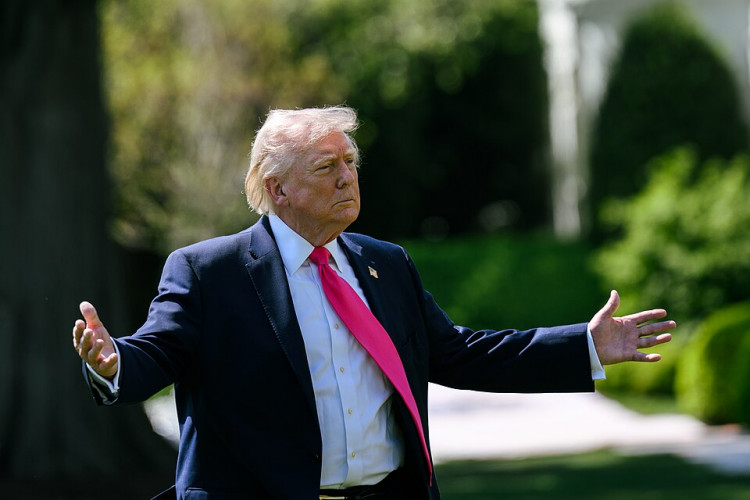
Donald Trump is facing renewed backlash from public health experts and Democratic lawmakers after reportedly dismissing concerns over hantavirus outbreaks as "false pandemics" and signaling that his administration would reject any future lockdown measures, even as health authorities investigate a deadly cluster tied to a cruise ship in South America.
The controversy erupted after three passengers aboard the Dutch-flagged vessel MV Hondius died from hantavirus-related illness, prompting intensified monitoring by health agencies and reigniting political arguments over how governments should respond to emerging infectious diseases in the post-COVID era.
According to reports circulating Sunday, Trump privately told aides he would not support renewed shutdowns or sweeping emergency restrictions tied to what he allegedly described as "false hantavirus pandemics." A widely shared social media post summarizing the remarks spread rapidly online, fueling clashes between Trump supporters and critics over the administration's public-health posture.
The White House has not publicly issued a formal transcript of the reported comments. But Trump later sought to reassure Americans that the situation remained contained, telling People Magazine the outbreak was "very much, we hope, under control."
Federal health officials have emphasized that hantavirus differs significantly from COVID-19 and currently poses no comparable pandemic threat. The virus is primarily transmitted through contact with infected rodent urine, droppings or saliva, and health authorities investigating the MV Hondius outbreak say there is no evidence of sustained human-to-human transmission.
Passengers are believed to have been exposed during excursions in rodent-heavy regions of South America before boarding the vessel. Symptoms of hantavirus infection often begin with fever, fatigue and muscle aches before progressing in severe cases to respiratory failure.
Still, the outbreak has intensified scrutiny of the administration's public-health infrastructure after recent reductions in staffing and infectious-disease funding.
The New York Times reported that cuts at the Centers for Disease Control and Prevention have weakened outbreak response capabilities, including reductions in epidemiology teams and field investigators. The Guardian separately noted that while the World Health Organization does not classify hantavirus as a pandemic-level threat, the outbreak has exposed broader vulnerabilities in U.S. preparedness systems.
Public-health experts warned that minimizing emerging disease threats can complicate early response efforts, even when the immediate risk to the public remains relatively low.
At the same time, Trump's stance has drawn strong support from conservative allies who argue the administration is resisting the kind of sweeping emergency powers used during the COVID-19 pandemic.
Jay Bhattacharya, speaking in a CNN report, argued that hantavirus requires a more targeted strategy rather than broad social restrictions.
"Hantavirus is not COVID," Bhattacharya said, urging officials to focus on limited containment measures instead of large-scale shutdowns.
The debate is rapidly taking on political dimensions as Washington moves closer to the 2026 midterm elections. Democratic lawmakers are reportedly calling for congressional hearings into outbreak preparedness and questioning whether recent reductions in public-health staffing have undermined the nation's ability to react to emerging infectious diseases.
Republicans, meanwhile, are framing Trump's position as a defense of economic stability and personal liberty after years of political fallout from COVID-era mandates.
The administration has already made opposition to future lockdowns a broader ideological message. Trump repeatedly campaigned on promises that the United States would never return to the shutdown policies that defined the early stages of the coronavirus pandemic, arguing those measures damaged businesses, schools and public trust.
Federal agencies say contact tracing tied to the MV Hondius cases remains ongoing, and officials continue monitoring passengers and crew members connected to the outbreak. No federal lockdown plans are currently under consideration, according to health authorities.