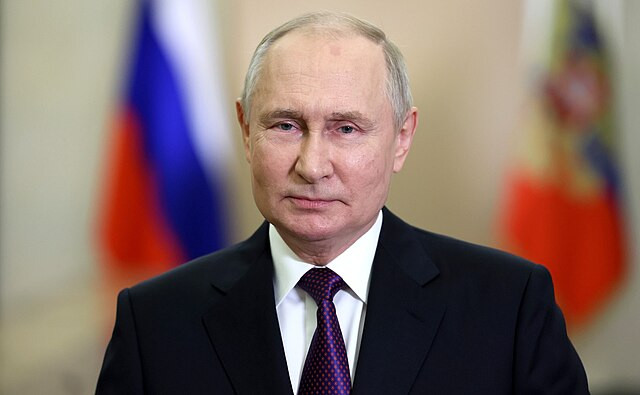
Vladimir Putin publicly confronted long-running conspiracy theories about his identity this week after his former schoolteacher, 92-year-old Vera Gurevich, appeared to question whether the man greeting her in Moscow was really the Russian president himself.
The exchange unfolded during a heavily choreographed Kremlin media event ahead of a formal dinner in Moscow, where Russian state television showed Putin arriving personally to escort Gurevich to the Kremlin. The moment quickly drew international attention after Gurevich looked closely at Putin and asked, "Is that you?"
"Yes, it's me. It's me," Putin replied, repeating himself in what observers viewed as one of his clearest public responses yet to persistent rumors that the Kremlin uses body doubles or stand-ins for the Russian leader during public appearances.
The theory that Putin employs doubles has circulated for years across Russian opposition channels, Western tabloids and social media forums, fueled by speculation surrounding his health, security precautions and occasional changes in appearance. More extreme versions of the conspiracy theory claim the "real" Putin is dead and has been replaced entirely - allegations unsupported by credible evidence and never confirmed by Western intelligence agencies.
Still, the secrecy surrounding the Kremlin and Putin's tightly managed public image has allowed such narratives to persist, particularly since Russia's invasion of Ukraine intensified scrutiny around the president's movements and physical condition.
The Moscow meeting appeared carefully designed to counter those suspicions. Putin, 73, was shown driving an Aurus off-road vehicle himself - an unusual visual departure from his typical chauffeur-driven appearances. The imagery projected vigor and control, reinforcing the Kremlin's longstanding effort to portray the president as physically capable and firmly in command.
After her initial hesitation, Gurevich embraced Putin, kissed him several times on the cheek and accepted a bouquet of flowers. Russian state media framed the encounter as a sentimental reunion between an aging teacher and her former pupil who rose to become leader of Russia.
Yet even the supposedly spontaneous elements of the event quickly drew scrutiny.
During the hotel lobby sequence, cameras captured Putin greeting a man introduced by Russian media as a tourist visiting from Sochi. The man engaged in casual conversation with the president about the Black Sea city, helping create the appearance of an unscripted public interaction.
Independent Russian outlet Agentsvo later identified the man as Alexander Bazarny, who reportedly works for a company managing luxury villas in Sochi allegedly linked to Putin and to relatives of Alina Kabaeva, widely reported to be close to the Russian president.
Agentsvo also reported connections between the company and Russian intelligence-linked networks, though the Kremlin did not comment on those claims.
The episode reinforced a recurring paradox surrounding Putin's public appearances: the more carefully staged the events appear, the more they can fuel speculation among critics who already distrust official narratives.
Gurevich herself has long played a role in shaping the mythology surrounding Putin's early life. Over the years, Russian media have frequently highlighted her stories about the future president's childhood personality and behavior.
In one anecdote repeatedly cited in documentaries and profiles, she recalled a teenage Putin killing a duck during a school outing. "He pulled a blanket over himself, covering his head completely," Gurevich once said. "He said, 'Bring in the unfortunate one, lay her head so that, without seeing her, I can sever her head with a single blow.'"
She has also described the young Putin as academically capable but emotionally reserved, once remarking that "it'd be Vladimir Putin who'd become president, head of our great state" was something she never expected, believing instead he would likely become a lawyer.
The Kremlin frequently balances these softer, nostalgic stories with images of Putin as wartime commander-in-chief alongside military figures such as Valery Gerasimov. The contrast forms part of a broader effort to present Putin simultaneously as a relatable citizen and an indispensable national leader.