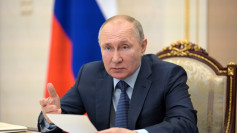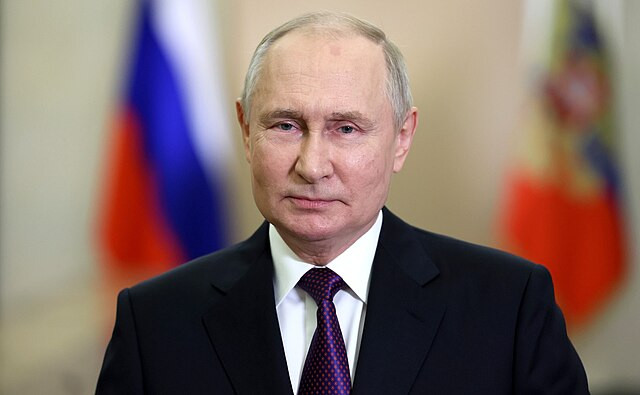
Russian President Vladimir Putin used one of Moscow's highest-profile international gatherings to weigh in on the escalating Middle East crisis, defend U.S. President Donald Trump against criticism over Iran policy and issue fresh warnings about nuclear dangers tied to both Iran and the war in Ukraine.
Speaking during the plenary session of the St. Petersburg International Economic Forum, Putin presented Russia as an active participant in diplomatic discussions involving Washington, Tehran and Tel Aviv. His remarks came as international attention remains focused on Iran's nuclear program, the conflict between Israel and Iran, and continuing concerns over the safety of nuclear facilities in both the Middle East and Eastern Europe.
The Kremlin said delegates from 140 countries and territories attended the forum, giving Putin a global audience as he sought to position Russia as an indispensable player in major geopolitical disputes despite ongoing tensions with Western governments.
A significant portion of the discussion focused on allegations that Iran is secretly pursuing nuclear weapons. Asked about Tehran's stockpile of enriched uranium and whether it should be transferred to international oversight, Putin rejected suggestions that Iran is actively seeking a nuclear arsenal.
"I have no reason to say that Mr. Trump has been misled in any way," Putin said when questioned about whether Israeli Prime Minister Benjamin Netanyahu had influenced the American president's position on Iran.
Putin went on to describe Trump as "an experienced, mature politician" and argued that the U.S. leader was capable of making independent decisions based on available intelligence and diplomatic assessments.
While acknowledging Israeli security concerns, Putin said Iran has consistently denied seeking nuclear weapons and argued that Moscow has not seen evidence proving otherwise. He suggested that greater international oversight could help reduce tensions and rebuild trust among the parties involved.
"If Iran's uranium were placed under IAEA supervision," Putin indicated, the path toward a diplomatic solution would become considerably easier.
The Russian leader also devoted substantial attention to the Bushehr nuclear power plant in southern Iran, one of Russia's most significant energy projects abroad. Bushehr remains a symbol of the long-standing partnership between Moscow and Tehran, particularly in the nuclear energy sector.
Putin said one reactor at the facility is operational while construction continues on two additional units. He acknowledged that Russia had reduced its personnel presence because of security concerns surrounding regional military activity.
According to Putin, Russian officials raised concerns directly with both Washington and Jerusalem after military operations occurred near the facility.
He said Russia received assurances that accidental incidents near Bushehr would not be repeated. Moscow has increasingly emphasized the risks posed by military activity around civilian nuclear infrastructure as regional tensions continue to rise.
Putin then shifted the discussion toward Ukraine and the Zaporizhzhia nuclear power plant, Europe's largest nuclear facility. The site has remained a focal point of international concern since Russian forces seized control of the plant early in the war.
The Russian president alleged that Ukrainian forces had carried out attacks near the facility and claimed that the reactor itself had been targeted, though he said the strikes produced no significant damage.
More concerning, Putin argued, are the plant's spent nuclear fuel storage areas. Damage to those facilities, he warned, could create radioactive contamination capable of affecting areas far beyond Ukraine.