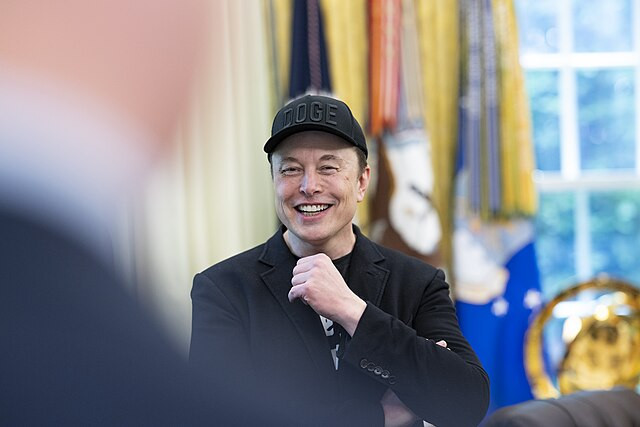
Elon Musk became the first person in history to surpass a net worth of $1 trillion following the long-awaited public offering of SpaceX, a landmark event that transformed the aerospace company into one of the most valuable corporations in the United States and cemented Musk's position at the top of the global wealth rankings.
The SpaceX debut delivered one of the largest wealth-creation events in modern corporate history. Regulatory filings and market estimates indicate that Musk's majority ownership stake in the company is now worth approximately $866 billion alone, accounting for the largest share of a fortune that spans electric vehicles, artificial intelligence, aerospace, biotechnology and infrastructure ventures.
The milestone marks a dramatic escalation in Musk's wealth trajectory. Just five years ago, he became the world's richest person when Tesla's stock surged during a period of rapid growth in the electric vehicle industry. At the time, his fortune briefly exceeded $300 billion. The latest jump places him in an entirely different category of wealth, one driven by the rising valuations of both public and private technology companies.
SpaceX's public offering had been anticipated for years. Musk repeatedly resisted pressure to list the company, preferring to fund its expansion through private investment rounds. Those funding rounds steadily increased the company's valuation, with secondary share sales pushing its private worth beyond $350 billion before the initial public offering.
Investor demand for the IPO proved exceptionally strong, according to reports, with the offering oversubscribed multiple times. The enthusiasm reflected Wall Street's growing appetite for companies operating at the intersection of commercial spaceflight, satellite communications and national security.
The company now occupies a central role in both the commercial and government space sectors. Since its founding in 2002, SpaceX has evolved from an ambitious startup into a critical partner for NASA and the U.S. Department of Defense.
Among its major businesses are:
- Falcon 9 launch services
- Falcon Heavy heavy-lift missions
- Starship spacecraft development
- Starlink satellite internet operations
- Government and defense contracts
- International Space Station cargo and crew transportation
Starlink has become one of the company's most valuable assets. The satellite internet network operates thousands of satellites in low-Earth orbit and serves customers across numerous countries. Analysts have increasingly viewed Starlink as a major growth engine capable of generating recurring revenue on a global scale.
The SpaceX listing also produced significant gains for employees. Because the company broadly distributed stock compensation over the years, thousands of current and former workers reportedly benefited from the surge in valuation following the public debut. Engineers, executives and long-serving staff members suddenly found themselves holding shares worth far more than many had anticipated.
SpaceX's success represents only one part of Musk's business empire. He remains one of the largest shareholders of Tesla, which continues to rank among the world's most valuable automotive manufacturers despite increased competition in the electric vehicle market.
His influence has expanded further through xAI, the artificial intelligence company launched in 2023. The venture has rapidly emerged as a major competitor in the AI sector, challenging established firms including OpenAI and Anthropic while investing heavily in computing infrastructure and advanced AI systems.
Other ventures under Musk's control include Neuralink, which develops brain-computer interface technology, and The Boring Company, which focuses on transportation and tunneling projects. Together, the businesses have created a portfolio spanning multiple industries that investors increasingly view as interconnected bets on future technologies.