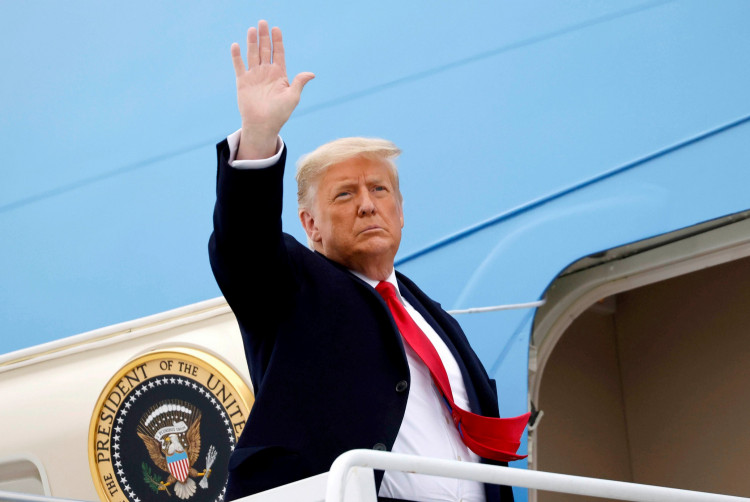
President Donald Trump remains the dominant force in Republican politics, but conversations about who will lead the party after him are already intensifying behind the scenes, according to comments from former Republican strategist Rick Wilson, who says a growing number of ambitious Republicans are quietly positioning themselves for a potential 2028 presidential run.
Wilson, a co-founder of the anti-Trump Lincoln Project, told Raw Story that Republican operatives, donors and elected officials are increasingly focused on what the party will look like after Trump leaves the political stage. While no major candidate has formally launched a 2028 campaign, he said preparations are already underway in political circles.
"The number of Republicans who are planning to run in 2028 is growing by the minute," Wilson told Raw Story.
The remarks highlight a challenge that often confronts dominant political movements: succession. Trump has reshaped the Republican Party around his political brand, leaving potential heirs to navigate the difficult balance between embracing his influence and establishing independent identities.
According to Wilson, many Republicans who previously delayed their ambitions while Trump pursued another White House term are now reconsidering their timelines. He claimed some party insiders increasingly view Trump's age as a factor in long-term political planning.
"They think Trump is going to croak," Wilson said, describing what he characterized as private conversations among Republican strategists. Wilson offered no evidence to support that claim, and there has been no official indication of serious health concerns surrounding Trump.
Wilson estimated that "close to 20" Republicans could eventually enter the race to succeed Trump. He suggested the field may include senators, governors and House members who have spent years waiting for an opportunity to compete for the party's highest office.
"It will be people from Congress, from the Senate, governors, they're all going to get in because they're going to see the end of the Trump era. They're going to claim the throne of MAGA," Wilson said. "Ambition is a hell of a drug."
The prospect of a crowded Republican primary could create new tensions within the party. Trump has historically maintained a strong influence over Republican candidates and officeholders, often rewarding allies while criticizing those perceived as rivals. A growing number of potential successors competing for support from Trump's voter base could complicate that dynamic.
Wilson predicted early signs of a 2028 contest may emerge as soon as next year. "I think we're going to see a real mess starting in the spring of next year," he said.
Among the names Wilson discussed were Vice President JD Vance and Secretary of State Marco Rubio, both of whom are widely viewed by political observers as influential figures within the current administration. Neither has announced plans to run for president.
Wilson argued that timing could become a challenge for potential candidates seeking Trump's backing. Referring to Rubio, he said, "Marco has peaked way too early. He's the golden child for Trump and MAGA world, but it's so early."
For Vance, the political equation may be more complicated. As vice president, he occupies one of the most visible positions in the administration and could emerge as a natural contender should he decide to pursue higher office. At the same time, his political future remains closely tied to the success or failures of the Trump administration.
Wilson suggested voters may begin seeing familiar presidential campaign patterns long before any formal announcements are made. "Watch the spring of next year, you're going to see a lot of people suddenly visiting New Hampshire, suddenly visiting Iowa, suddenly announcing the 'American Dream super PAC' and writing terrible campaign books," he said. "That's become sort of one of the things, the ritual."
For now, discussions about a post-Trump Republican Party remain largely speculative. No major Republican figure has formally declared a 2028 candidacy, and Trump continues to dominate the party's political landscape. Yet the early maneuvering described by Wilson reflects a growing reality in Washington: even as Trump remains at the center of Republican politics, attention is increasingly turning toward who might eventually inherit the movement he built.