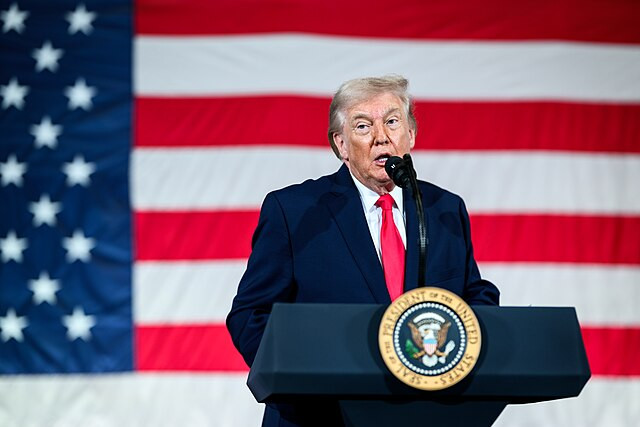
President Donald Trump announced Thursday that a U.S.-led diplomatic initiative had reached an agreement to disarm Hamas and other armed groups in Gaza, describing the development as a key step toward reshaping governance in the Palestinian enclave. Hours after the announcement, however, a senior Hamas official said the group would only move forward if Israel first fulfilled previously negotiated commitments, including ending military operations, withdrawing troops and expanding humanitarian access.
The differing accounts underscored the uncertainty surrounding the latest effort to stabilize Gaza after months of conflict. While Trump portrayed the agreement as a breakthrough in implementing his administration's postwar framework, Hamas indicated that disarmament remains contingent on actions by both Israel and the United States before any phased process can begin.
Speaking to Reuters, Ghazi Hamad, a Hamas official, said mediators had been informed that Israel must honor commitments already discussed during negotiations.
"We insisted to the mediators that Israel must abide by the agreement," Hamad told Reuters. According to Hamad, those commitments include halting attacks inside Gaza, reducing the Israeli military presence in the territory and allowing a greater flow of goods and humanitarian supplies into the enclave.
Trump, in a post on social media, presented the agreement as part of a broader plan to establish a new governing structure for Gaza after the war. He said the arrangement would combine security guarantees for Israel with the creation of a new Palestinian administration supported by an international stabilization effort.
"This is a critical step towards Gaza finally being governed by a new Palestinian government that will work closely with the Board of Peace to help the Palestinian people," Trump wrote. He added, "at the same time, Israel will have the security it deserves, with Gaza no longer used as a base for terror attacks."
The president said the initiative forms part of what he called the Trump 20-Point Plan, outlining a phased implementation process that would link the disarmament of militant groups to changes in Gaza's security structure.
"This is a major milestone in the implementation of the Trump 20-Point Plan. The agreement will be carried out in carefully structured phases. As disarmament is completed, Israeli forces will withdraw, and the International Stabilization Force will work with a new Palestinian police force to take responsibility for Gaza being safe for its residents and its neighbors," Trump wrote.
He concluded the announcement by stating, "The threat that emerged from Gaza on October 7 will NOT be allowed to rebuild! Under this agreement, Gaza will finally be in the hands of a new Palestinian government that serves its PEOPLE."
Despite the announcement, key implementation questions remain unresolved. Neither Trump nor Hamas clarified which side would be expected to act first, leaving uncertainty over how the phased process could begin if each party expects prior commitments from the other. Israeli officials also did not publicly comment on Trump's announcement or provide details regarding the proposed sequence of implementation.
The announcement comes as Israel has taken steps toward allowing an international security presence inside Gaza. Reuters reported that Israel's security cabinet approved the legal framework permitting the deployment of a multinational stabilization force that would operate in areas outside direct Israeli military control.
According to Reuters, the proposed force would initially include approximately 200 personnel drawn from countries described as friendly to Israel, including Uganda and Morocco. The report said Israel would retain authority to approve each participating contingent before deployment, although no timetable has been announced for when those personnel might enter Gaza.