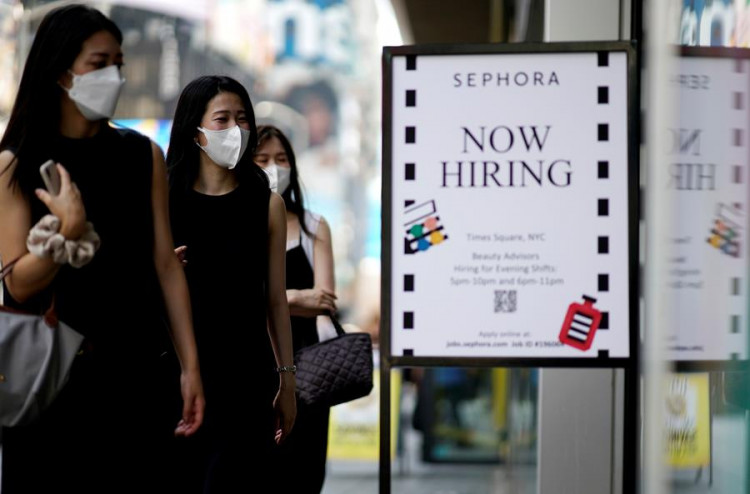
The U.S. labor market delivered conflicting signals in May as job openings climbed to their highest level in two years, even while employers hired fewer workers and consumer confidence in finding employment continued to deteriorate, underscoring the complex economic backdrop confronting policymakers ahead of upcoming Federal Reserve decisions.
Fresh data released by the U.S. Bureau of Labor Statistics showed there were 7.594 million available positions at the end of May, exceeding economists' expectations and suggesting that demand for workers remains resilient despite elevated borrowing costs, persistent inflation concerns and uncertainty surrounding the global economy. Yet beneath that headline, hiring activity weakened for a second consecutive month, indicating companies are becoming more cautious about filling vacancies.
The latest figures from the Bureau's Job Openings and Labor Turnover Survey, commonly known as JOLTS, showed employers added fewer workers despite maintaining a large number of advertised positions. Hiring declined by 45,000 during May to 5.17 million, while the overall hiring rate remained unchanged at 3.3%.
The divergence between strong labor demand and slowing hiring has prompted economists to question whether employers are delaying recruitment decisions rather than aggressively expanding payrolls. Industries including transportation, warehousing and utilities recorded notable declines in hiring, with construction and wholesale trade also experiencing softer employment activity.
Matthew Martin, senior U.S. economist at Oxford Economics, told Reuters, "The labor market continues to show signs of stabilization." He added, "For Fed officials, this means their attention will stay focused on the inflation mandate and ensuring price stability."
The JOLTS report also contrasts with recent monthly payroll reports, which have generally shown stronger-than-expected job creation. That discrepancy has led some analysts to caution that previously reported employment gains could eventually be revised lower or that hiring conditions deteriorated more sharply toward the end of May than headline payroll figures initially suggested.
Veronica Clark, an economist at Citigroup, told Reuters, "We were surprised to see the total hiring rate unchanged and the private hiring rate decline again in May despite stronger May job growth." She added, "This could mean possible revisions lower to May data or weaker net job growth."
Separate data released Tuesday by the Conference Board suggested that American workers are becoming increasingly uneasy about their employment prospects. The share of consumers who said jobs are "hard to get" rose to 22.5% in June, the highest reading since January 2021. Meanwhile, the percentage of respondents who described jobs as "plentiful" remained virtually unchanged at 24.9%.
Conference Board Chief Economist Dana Peterson said, "Consumers anticipate little change in the labor market six months from now." Historically, economists have viewed the organization's survey as a reliable indicator of broader labor market conditions because perceptions about job availability often move alongside changes in unemployment.
The employment picture also varied significantly depending on company size. Businesses with fewer than 10 employees reduced job openings by approximately 132,000 during May, while nearly all of the month's increase in vacancies came from firms employing between 10 and 249 workers. The figures suggest that smaller businesses, which often face greater financing pressures from higher interest rates, may be pulling back more aggressively than larger employers.
Other labor market indicators pointed toward growing caution among workers themselves. Layoffs increased modestly by 41,000 to 1.708 million during May but remained historically low. At the same time, voluntary resignations rose only slightly to 3.065 million, leaving the quits rate unchanged at 1.9%.