President Donald Trump said the United States intends to take on a long-term security role in the Strait of Hormuz and collect compensation from commercial shipping using the strategic waterway, outlining a proposal that would dramatically expand Washington's role in one of the world's most important energy transit corridors as tensions with Iran continue to escalate.
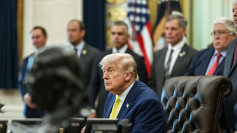
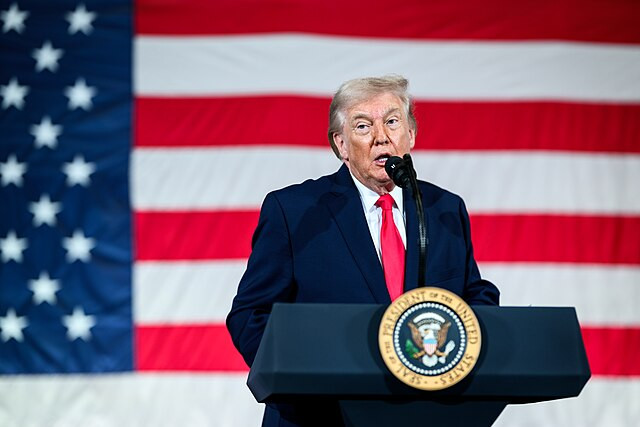
Speaking on Fox News' Fox & Friends, Trump argued that the United States should no longer provide maritime security in the Gulf without financial compensation, saying the U.S. would effectively become the guardian of the narrow shipping passage connecting the Persian Gulf to global markets.
"We will become the guardian of the strait, and we should be reimbursed for that," Trump said during the interview. He added that the United States "can't be expected to do that for nothing like we have for many years."
Trump later expanded on the proposal in a social media post, announcing that the United States would restore its blockade of Iranian ports while allowing other nations to continue using the Strait of Hormuz. According to the president, the blockade "is only stopping Iran's ships or customers from entering or leaving."
He further declared, "All other countries will have fair and open use of the Strait. The U.S.A. will be, from this point forward, known as 'THE GUARDIAN OF THE HORMUZ STRAIT,' but as such, and as a matter of FAIRNESS, will be reimbursed, at the rate of 20% on all cargo shipped, for any and all costs necessary to do the job of providing safety and security to this very volatile section of the World."
The proposal follows renewed military confrontations between Washington and Tehran centered on the strategic waterway. The United States has maintained that commercial shipping remains open, while Iran has asserted greater control over vessel movements after a series of attacks and interceptions in the region.
Trump also accused Tehran of violating previous understandings intended to reduce hostilities.
"We had a deal. it was a done deal. and then they broke it. they always break it," Trump said, adding that the United States would "keep the strait" and "probably run it."
Shipping data cited by Reuters illustrates the economic importance of the dispute. According to Kpler data referenced by the news agency, vessel traffic through the Strait of Hormuz fell to a five-week low on Sunday, with only six ships transiting the passage. The slowdown came amid conflicting claims over whether commercial navigation remains unrestricted.
Iran's Revolutionary Guard said Monday that it had stopped two vessels after shutting down their systems, while U.S. officials continue to insist the waterway remains open under American protection.
Iran, meanwhile, rejected Washington's characterization of recent diplomatic discussions.
Iranian Foreign Ministry spokesperson Esmaeil Baghaei told the state news agency IRNA that the United States "violated its commitments" under previous understandings. He also dismissed reports that the latest negotiations involved Iran's nuclear program.
According to Baghaei, the discussions "were solely focused on the issue of the Strait of Hormuz" and Iran's efforts "to reach a mechanism in consultation with Oman that would ensure the safe passage of ships through the Strait of Hormuz."
Baghaei further claimed that negotiations involving Oman ultimately failed because of "overt and covert pressure from the U.S. on Oman."
The Iranian official also defended Tehran's military operations following recent U.S. strikes, saying Iranian forces were targeting only "the bases, facilities, and positions used by the United States to attack Iran, including its logistical and support facilities."
According to Iranian state media, Tehran launched strikes against facilities in Kuwait, Bahrain, Jordan, Oman and Qatar. CNBC separately reported that air raid sirens sounded for a third time in Bahrain on Monday.