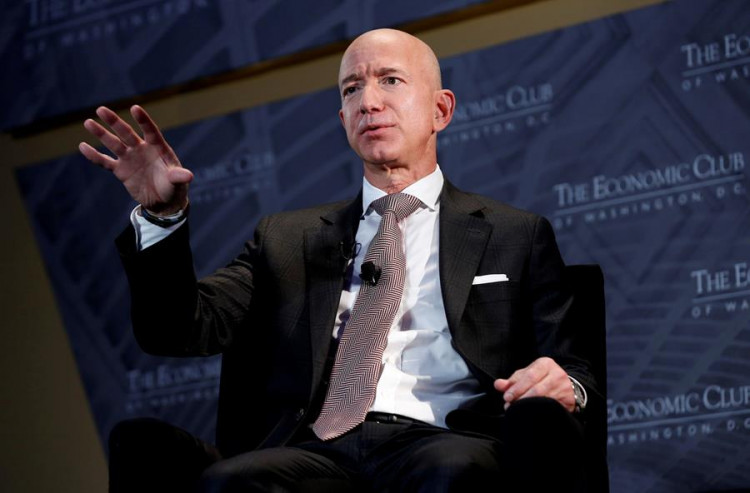
Amazon Executive Chairman Jeff Bezos plans to sell approximately 15 million Amazon shares valued at more than $4.07 billion, according to a Form 144 filing with the U.S. Securities and Exchange Commission, a move that drew immediate attention from investors after the company's blockbuster quarterly earnings report and a sharp rally in its stock price.
The planned sale comes just days after Amazon reported stronger-than-expected second-quarter results, fueling a surge of more than 22% in its shares over the past week. While insider stock sales are common among founders, the timing prompted CNBC's Jim Cramer to describe the transaction as a "buzzkill" for investors celebrating the company's latest financial performance.
Following disclosure of the filing, Amazon shares fell about 1.7% in premarket trading Tuesday, giving back a portion of the gains that followed the earnings announcement.
Amazon exceeded Wall Street expectations during the second quarter, reporting earnings of $5.75 per share on $200.61 billion in revenue. The company also projected third-quarter operating income between $22.5 billion and $26.5 billion, significantly above the $17.4 billion reported during the same period a year earlier.
Key second-quarter highlights included:
- Revenue: $200.61 billion
- Earnings per share: $5.75
- Projected Q3 operating income: $22.5 billion to $26.5 billion
- Amazon stock gain before filing: More than 22% over five trading days
Bezos has regularly sold Amazon shares over the years, often using proceeds for philanthropic initiatives and personal investments. Market observers, however, have long pointed to another destination for much of that capital: Blue Origin, the aerospace company Bezos founded to compete with Elon Musk's SpaceX.
"The only reason we are taking Blue Origin more seriously is because Bezos is bankrolling it," Space Capital investor Chad Anderson told The New York Times in December 2024. "They have spent a ridiculous amount of money."
Anderson estimated Blue Origin's spending at approximately $14 billion at the time. More recent reports suggest those investments have continued to accelerate as the company expands its ambitions in commercial spaceflight and satellite infrastructure.
The latest Amazon stock sale follows reports that Blue Origin is seeking $10 billion in new financing at a $130 billion pre-money valuation. According to reports, Coatue Management is expected to lead the fundraising effort with a $4 billion investment, while Bezos intends to contribute an additional $2 billion of his own capital.
Despite that valuation, Blue Origin remains substantially smaller than SpaceX, whose higher valuation reflects years of successful reusable rocket launches, a dominant commercial launch business and recurring revenue from the Starlink satellite network.
The capital requirements facing Blue Origin continue to grow. According to the Financial Times, the company could spend roughly $5 billion this year as it increases launch activity, bringing its cumulative investment since founding to approximately $28 billion.
The spending surge comes after Blue Origin suffered a major setback in May when its New Glenn rocket exploded during an engine-fire test at Launch Complex 36 in Cape Canaveral, Florida. The accident reportedly caused more than $1 billion in damage to launch infrastructure. Even so, Chief Executive Dave Limp has said the company expects New Glenn to return to flight before the end of 2026.
Beyond launch services, Blue Origin is pursuing several capital-intensive projects aimed at expanding its presence in the emerging space economy. Among them is Project Sunrise, which envisions deploying more than 51,000 satellites to support space-based artificial intelligence data centers, alongside the planned TeraWave communications network consisting of 5,400 low-Earth-orbit satellites and 128 medium-Earth-orbit optical relay satellites.