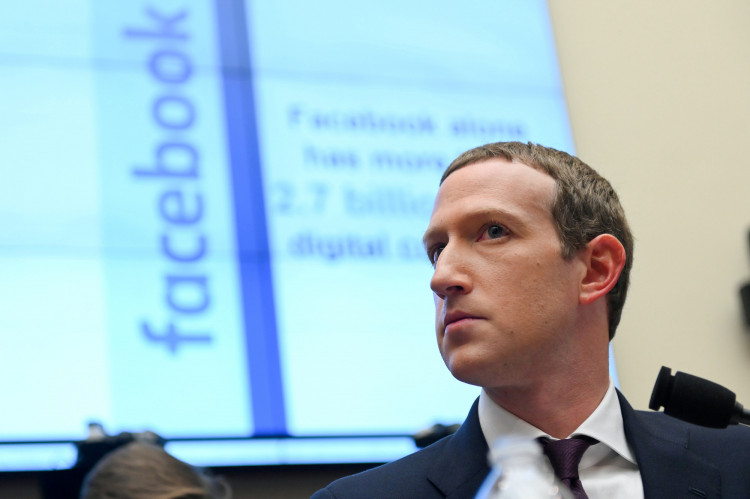
Meta CEO Mark Zuckerberg pushed back against calls for a coordinated slowdown in frontier artificial-intelligence development, arguing that AI companies already have powerful commercial and legal incentives to make their systems safe and aligned with users.
Zuckerberg's position puts Meta closer to Nvidia CEO Jensen Huang in a widening debate among Silicon Valley leaders over whether the industry should collectively slow advances in increasingly capable AI models. Anthropic CEO Dario Amodei has called for more deliberate pacing, an approach that drew support from OpenAI CEO Sam Altman, Elon Musk and Google DeepMind CEO Demis Hassabis.
"There is a lot of debate about slowing progress on capabilities until alignment catches up," Zuckerberg wrote on social media. "My view is that trust and alignment are quickly becoming the most important capabilities that will differentiate agents and models. Any lab that doesn't focus on alignment will fall behind."
Zuckerberg argued that competitive pressure itself provides one layer of protection because "people won't want to use agents that are misaligned with them" and, as a result, "labs have a strong natural incentive to make their models more aligned."
Legal exposure provides another check, he said. "Labs face significant liability if their models cause harm, so they have a strong incentive to prevent this as well."
That doesn't mean Meta believes companies should race ahead regardless of warning signs. Zuckerberg pointed to Meta's decision to delay its personal AI agent Muse for several months while engineers worked on safety and security issues as evidence that individual laboratories can adjust their own development schedules when necessary.
"We didn't call for everyone else to do this before we would," Zuckerberg wrote. "We just did it as part of our day-to-day work because it was clearly the right thing for people and for us. I'm proud of the security foundations we've built."
His argument differs from Amodei's proposal in an important respect. The Anthropic chief has urged frontier laboratories to coordinate more broadly so that safety work has time to keep pace with rapidly advancing capabilities, including through shared standards, independent evaluators and international cooperation.
Zuckerberg supports outside testing but doesn't view it as requiring an industrywide slowdown. He described third-party testing and auditing as "industry best practice" and called for a larger pool of independent evaluators.
"MSL already does this today in several areas because it helps produce better work. Other labs can just do this too. In general, it would be helpful for there to be a larger and more diverse ecosystem of evaluators," Zuckerberg said.
The disagreement comes as some of Meta's biggest rivals are already discussing joint approaches to AI safety. OpenAI global policy chief Chris Lehane said Tuesday that OpenAI has been working with Anthropic and Google DeepMind for several weeks on safety issues.
"It's better to try to work together to prioritize safety," Lehane said.
Lehane said OpenAI doesn't believe the companies require an antitrust waiver to cooperate on safety. Amodei had proposed a narrow government waiver that would allow AI developers to coordinate on specified safety issues without creating competition-law concerns.
OpenAI has also backed proposals that would bring independent evaluators into leading AI laboratories. Altman said over the weekend that he agreed with Amodei that the frontier needs to be paced, while emphasizing that the objective is to slow capability development relative to what would otherwise occur rather than halt AI progress.
Huang has taken a position closer to Zuckerberg's. The Nvidia chief said companies should pause or pace development if they believe their own operations are getting out of control, while rejecting broader predictions that AI will destroy humanity as not grounded in science.
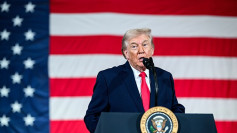
That distinction surfaced publicly Monday when President Donald Trump unexpectedly called Huang while the Nvidia CEO was appearing at the All-In Summit in Los Angeles.
"The robots will not be taking over. The AI will not be taking over the rest of the world. The whole thing is a hoax," Trump told Huang, referring to warnings about catastrophic AI risks. Trump argued that slowing development could benefit competitors, including China.
Huang responded: "We're going to make sure that everybody wins in the AI race of America. Every industry, every company, every state, every people." He has nevertheless said safety whistleblowers should be taken seriously and praised former Anthropic researcher Jacob Coxon for raising concerns about the pace of development.