Nvidia CEO Jensen Huang pushed back against broad regulation of artificial intelligence, arguing that governments should police the products and services built with AI rather than regulate the underlying technology itself as policymakers confront growing calls for tighter controls on advanced systems.
Speaking at an AI gathering hosted by King Charles III at Dumfries House in Ayrshire, Scotland, Huang drew a distinction between artificial intelligence and social-media platforms. He described AI as a foundational technology that can be incorporated into products across industries rather than a single consumer-facing service.
"Unlike social media, which is a product, AI is a technology that's behind all of these other tech, all of these products, and so regulate the products," Huang told journalists.
His comments place the Nvidia chief in a different part of the intensifying debate over how governments should respond to increasingly capable AI. Executives including Anthropic CEO Dario Amodei and OpenAI CEO Sam Altman have recently advocated greater caution around frontier development, including measures intended to address potentially dangerous capabilities before the most advanced systems are widely deployed.
Huang instead emphasized existing regulatory structures and traditional product-safety practices. Governments already regulate industries ranging from healthcare and transportation to financial services, and those frameworks can often be applied when AI becomes part of a regulated product, he argued.
"When something goes wrong, then you add to the existing laws," Huang said.
The approach would put more responsibility on companies to demonstrate that individual products are sufficiently tested before release rather than imposing broad restrictions on the development of AI models. Huang said many of the security problems associated with AI today stem from products being released before they are ready, rather than from the underlying technology itself.
"The security issues involving AI are related to products not ready to be released," Huang said.
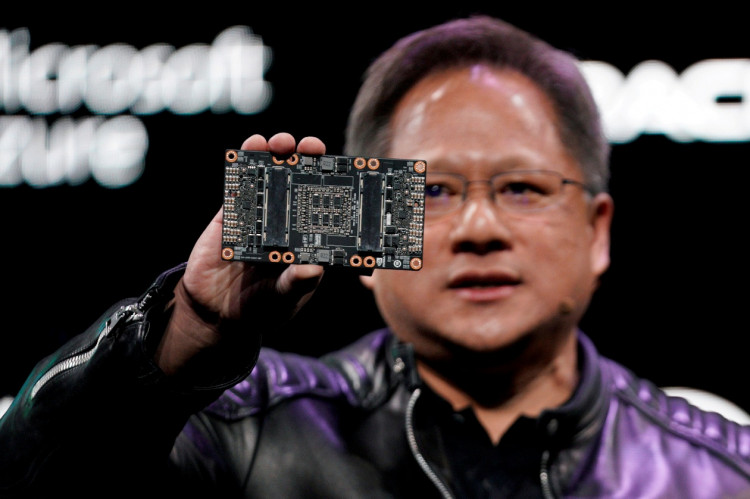
Nvidia occupies a particularly influential position in that debate. Its graphics processors and other computing systems have become essential infrastructure for training and operating advanced AI models, making the company one of the biggest beneficiaries of the global race among technology companies and governments to build AI capacity.
Huang argued that developers should subject AI-powered products to rigorous testing in controlled environments before releasing them. He characterized that process not as a fundamentally new regulatory challenge but as an extension of engineering practices used in other industries.
"That's engineering, good old-fashioned engineering. It's not more than that. It's not less than that," Huang said.
He compared unfinished AI systems with other products that wouldn't be released until they had passed appropriate safety checks.
"This is no different than, you know, an omelet's not ready to be released, or a car is not ready to be released, an airplane engine's not ready to be released," Huang said. "You should properly test it."
The distinction matters as governments consider whether AI requires technology-specific restrictions or can largely be governed through existing rules covering the products and industries where it is deployed. The European Union has moved toward horizontal AI regulation through its AI Act, while other jurisdictions have debated combinations of voluntary standards, sector-specific requirements and rules aimed at the most powerful models.
Huang repeated his product-focused approach during formal remarks at Dumfries House, where representatives from major AI companies, including OpenAI and Anthropic, joined discussions hosted by the King.
"When a product is not safe enough, we should hold it back and keep engineering. We've always done that, and we should continue to do that," Huang said.
The Nvidia chief's position doesn't dismiss AI safety concerns. Instead, it locates the principal responsibility at the point where AI becomes a product: developers should test systems, withhold those that aren't ready and comply with the rules governing the industries in which they operate.