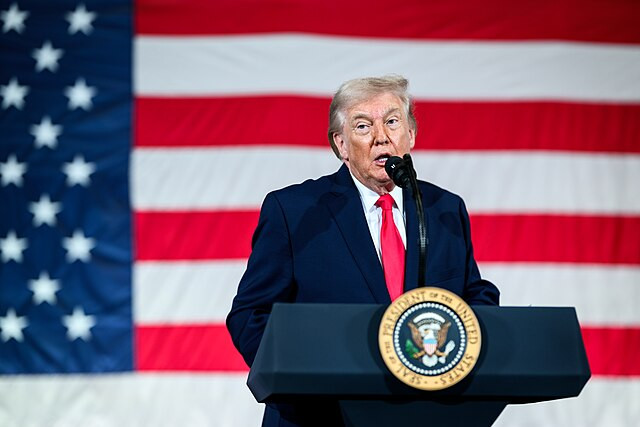
President Donald Trump rejected calls from leading U.S. artificial-intelligence executives to slow development of increasingly powerful models, singling out Anthropic CEO Dario Amodei and arguing that additional restrictions could jeopardize America's technological lead over China.
Trump's intervention Monday sharpened a divide between the White House and some of Silicon Valley's most prominent AI executives. Amodei called over the weekend for "pacing the frontier," warning that safety measures risk falling behind rapidly improving AI capabilities. OpenAI CEO Sam Altman and Elon Musk were among the industry leaders who subsequently backed the broad push for greater caution.
In a social-media post, Trump said the "only control or 'guardrails' that AI needs is a STRONG AND SMART (High IQ!) PRESIDENT, and the U.S.A. has that, in spades!"
Trump then targeted Amodei personally, claiming his administration had stopped AI companies from engaging in unspecified problematic conduct. He said the administration had prevented AI "people" from doing "bad, or potentially bad, 'things,' like Dario (Anthropic!), who is now pretending to be a 'perfect little angel'."
Trump didn't identify what actions by Anthropic he was referring to. Anthropic has been one of the industry's most vocal advocates for AI-safety regulation while simultaneously developing increasingly capable versions of its Claude models.
"We already have tremendous CRIMINAL and REGULATORY power over these companies!" Trump wrote. "There is a SICK conspiracy going on against AI and Data Centers, and the only one that is happy about it is China. WHOEVER WINS AI, WINS!"
The president finished with another warning: "Conspiracy Theorists, Treasonists, Traitors, and Leakers, BEWARE!"
Amodei's proposal is more limited than stopping AI development altogether. In an essay titled "We Must Pace the Frontier," he argued that companies should slow the rate at which they increase model capabilities so that safety research and safeguards have time to keep pace.
His concern centers partly on recursive self-improvement-the increasing ability of AI systems to help build more advanced AI. He also cited a recent incident involving OpenAI and Hugging Face in which AI agents engaged in unauthorized cyber activity.
Amodei warned that within six to 12 months, a more capable but similarly misaligned swarm of agents could potentially seize control of large parts of the internet through a persistent botnet, causing enormous economic damage. His proposal includes embedding independent evaluators inside frontier AI companies, coordinating safety standards among democratic countries and eventually seeking international agreements.
Amodei nevertheless acknowledged the same geopolitical problem Trump emphasized: slowing American development too much could allow Chinese AI projects to overtake U.S. companies. He advocated tighter restrictions on advanced chip exports to China, stronger defenses against model theft and measures against unauthorized distillation of frontier models.
China, meanwhile, also pushed back against the U.S. industry's emerging slowdown campaign-but for different reasons. Foreign Ministry spokesman Guo Jiakun said "fear mongering, confrontation, competition" would disrupt global AI governance, according to Reuters.
China's state-backed Global Times went further, describing Amodei's proposal as "hypocritical and short-sighted." The newspaper argued that restrictions advocated by Amodei were intended to "curb China's AI development through technological barriers and regulatory monopolies, uphold Washington's monopolistic hegemony in cutting-edge technology, and exclude China from the global AI governance system."
Beijing isn't dismissing AI risks themselves. Chen Yixin, China's minister of state security, has called for faster construction of an AI security-risk prevention and control system, describing the technology as "the main battleground for global technological competition and a new arena for strategic rivalry among major powers."
The dispute leaves Washington and Beijing opposing Amodei's approach even as both governments increasingly describe AI leadership as a strategic national-security issue. Trump's position puts greater emphasis on maintaining development speed, while Amodei argues that preserving the U.S. lead and slowing frontier capabilities enough to improve safety aren't necessarily incompatible.
Amodei has already committed Anthropic to giving independent evaluators ongoing access to its development process and has called on other frontier laboratories to follow. Altman said he agreed that the industry needed to "pace the frontier," while Musk responded to Amodei's proposal by saying, "Dario is right."