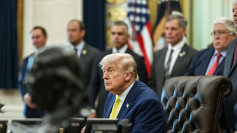
President Donald Trump ignited a fresh political controversy Monday after criticizing several Democratic-led cities as "filthy" during remarks from the Oval Office, comments that immediately drew backlash from political opponents who accused him of unfairly disparaging major American communities while reigniting debate over urban crime, public safety and local governance.
Speaking during a televised appearance, Trump shifted from prepared remarks to criticize large metropolitan areas run by Democratic officials, arguing that many have fallen into visible decline because of poor leadership and policy decisions.
"What else do they have in common?" Trump asked before answering his own question. "They're filthy dirty."
He expanded on the criticism by describing deteriorating public conditions in cities across the country.
Trump said many urban areas feature streets that smell, damaged storefronts and neglected public spaces, adding, "Everything about the place is dirty," before saying his criticism applied to "really all of them."
The remarks echoed themes Trump has emphasized throughout both his presidential campaigns and his second administration, frequently portraying Democratic-led cities as examples of failed governance, rising crime and declining quality of life.
The comments quickly spread across social media, where critics argued that a sitting president should avoid broad characterizations of American cities. Several users pointed out that Trump built much of his real estate empire in New York City, one of the nation's largest Democratic strongholds.
Others argued that major metropolitan areas remain central to the country's economic strength and questioned whether describing them in sweeping negative terms undermined efforts to promote national unity.
One widely circulated post accused Trump of criticizing the very country he represents, while another argued there was a contradiction between urging Americans to express patriotism and repeatedly portraying large U.S. cities in overwhelmingly negative terms.
Supporters, however, defended the president's remarks as reflecting concerns shared by many voters regarding homelessness, public safety, deteriorating infrastructure and quality-of-life issues in some urban centers.
The latest exchange fits into a broader pattern of confrontation between the Trump administration and Democratic-led cities since the president returned to office. Administration officials have repeatedly clashed with state and local leaders over immigration enforcement, crime policy, policing, homelessness and federal funding.
Trump has frequently singled out cities including Los Angeles, Chicago and Washington, D.C., arguing that stronger federal intervention is necessary to restore public safety and improve living conditions.
Local officials have disputed those portrayals, pointing to data showing declines in certain categories of violent crime while arguing that the administration selectively highlights negative trends without acknowledging broader improvements in public safety or economic activity.
The dispute extends beyond rhetoric. Earlier this year, Trump authorized deployments of National Guard personnel to several metropolitan areas, citing public safety concerns. Some governors and mayors criticized those actions, arguing they were undertaken without sufficient coordination and risked increasing tensions rather than reducing them.
Administration officials defended the deployments, saying the federal government has a responsibility to intervene when local governments fail to adequately protect public safety.
The broader conflict has also included disputes over federal funding. In May, Health and Human Services Secretary Robert F. Kennedy Jr. announced approximately $1 billion in Medicaid funding reductions affecting California and Minnesota, alleging irregularities in state Medicaid administration.
State officials rejected those allegations and disputed the legal basis for the reductions, while Kennedy said the department relied in part on artificial intelligence-assisted analysis during its review of the programs.