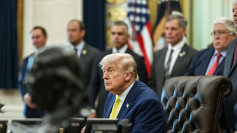
President Donald Trump was secretly moved from Air Force One through an airport catering truck and transferred to a smaller military aircraft during a trip from Turkey last month after U.S. intelligence raised concerns about a potential Iranian attack targeting the president or his plane, according to The Washington Post.
The extraordinary security maneuver left members of the White House press corps and some administration personnel aboard a decoy presidential aircraft while Trump departed separately. The operation, which unfolded amid heightened U.S.-Iran tensions, is now drawing questions from Congress over the severity of the threat and the precautions taken to protect the president.
Democratic Sen. Richard Blumenthal called the episode "unprecedented", "surreal", and "downright scary", and called for a congressional investigation into the circumstances surrounding the operation.
According to the Post, Trump was leaving Ankara after attending an international defense gathering when his security detail executed the switch. He had traveled to the summit aboard the newly retrofitted red, white and navy blue aircraft gifted by Qatar, but the White House said before his departure that he would use an older Air Force One jet for part of the return journey.
The administration initially said the Qatari-provided aircraft was being sent ahead so American military personnel stationed in eastern England could see it. Trump was subsequently photographed publicly boarding the older Boeing presidential aircraft for the scheduled trip to RAF Mildenhall in Suffolk.
What happened away from the cameras was considerably different, according to the Post. Trump and several aides exited through a service door on the opposite side of the aircraft and entered a hydraulically elevated catering truck positioned alongside the plane.
The vehicle, normally used to load food and other supplies onto commercial and government aircraft, provided a concealed way to move the president across the airport. Trump was then transferred to an Air Force C-32A, a smaller military aircraft used to transport senior U.S. officials.
Passengers aboard the larger presidential jet weren't immediately aware of the switch. Members of the traveling press corps were instructed to lower their window shades before departure, preventing them from observing activity elsewhere on the tarmac.
White House communications director Steven Cheung said the administration routinely adjusts presidential security measures in response to threats.
"As the President has said recently, there are many enemies of America who have their sights on him, and we use every tool at our disposal to address those threats," Cheung said in a statement.
The Secret Service declined to comment on the operation, according to the supplied reporting, while the Air Force referred questions to the White House.
The security precautions unfolded against an increasingly volatile confrontation between Washington and Tehran. While Trump was in Turkey, the U.S. military conducted retaliatory strikes inside Iran following attacks on commercial vessels in regional waterways.
U.S. intelligence agencies had raised urgent concerns about possible Iranian attempts to attack Trump or his aircraft, according to the Post. Those warnings contributed to additional precautions surrounding the president's departure and the decision not to initially use the Qatari-provided aircraft on that leg of the trip.
The episode also renewed questions about the security of the Qatar-gifted plane. Cheung defended the aircraft, saying it has sophisticated security systems designed to protect Trump and his staff, while Trump subsequently said additional technical upgrades would be made.
Trump's movements at RAF Mildenhall added another layer to the deception. Photographers documented the president leaving the older Air Force One after it arrived in Britain, indicating that he had been transferred back to the larger aircraft before members of the press were allowed to disembark.
Trump then boarded the Qatari-provided aircraft for the final flight to Joint Base Andrews outside Washington, according to the account.
Paul Eckloff, a former Secret Service special agent, said the unusual nature of the maneuver suggested officials were responding either to specific intelligence or exercising heightened caution because of the escalating regional confrontation.