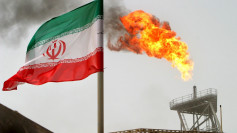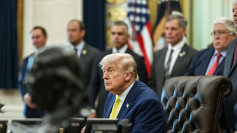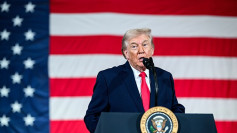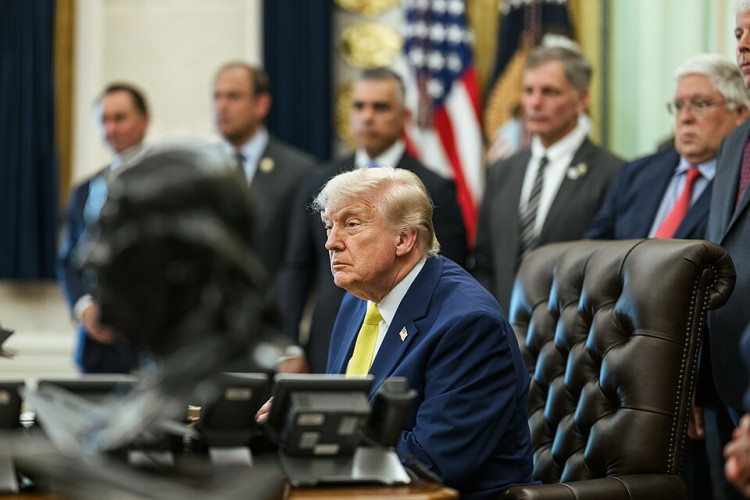
President Donald Trump said the United States will launch an "ECONOMIC D-DAY" against Iran, threatening penalties against foreign countries, banks and businesses that provide Tehran with a financial or commercial lifeline as Washington shifts its immediate focus from direct military escalation to economic pressure.
Trump described the coming campaign as the "most crushing economic operation ever taken against any country," signaling that the administration intends to extend pressure beyond Iran itself to governments and companies that continue dealing with the country.
"This will be Economic Warfare and Isolation on an unprecedented scale," Trump wrote in a social-media post, warning of major "economic consequences" for "ANY country that allows its financial institutions, businesses, airports, or government entities to provide any type of lifeline to Iran."
The announcement points toward a broad secondary-sanctions strategy aimed at making access to Iran economically risky even for entities outside the U.S. Such measures could significantly expand the reach of Washington's campaign by forcing foreign companies and financial institutions to choose between commercial ties with Iran and potential consequences from the United States.
Trump also called on U.S. allies to participate in the effort. "This will be an ECONOMIC D-DAY, and we need all of our Allies to stand with the United States of America to isolate, and defeat, the Iran threat. These maniacs are on the ropes, and these HISTORIC MEASURES will cripple them and their ability to project terror worldwide," he said.
Iran quickly rejected Trump's announcement. Foreign Minister Abbas Araghchi portrayed the threat as an attempt to divert attention from U.S. fiscal problems, citing America's "unprecedented debt & surging interest costs" as the national debt crossed the $40 trillion threshold.
"Doubling down on failed policies will only bring further defeat-and enmity of Iranians. US economic terrorism threatens global economy and sovereignty worldwide," Araghchi said.
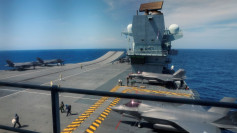
The economic confrontation is unfolding alongside a continuing U.S. military operation in the Strait of Hormuz, where American forces are helping commercial vessels move through the strategically important waterway despite Iran's efforts to restrict shipping, according to Axios, which cited officials familiar with the operation.
The U.S.-backed transit system is facilitating the movement of roughly 10 million barrels of oil a day, Axios reported. Between 15 and 20 tankers are entering and leaving the strait at night using a shipping channel near the coast of Oman.
American forces aren't merely escorting tankers through the passage. According to the report, the military is also helping ships reach regional oil producers to load cargo before assisting them as they travel back through the waterway.
"We have been controlling the southern lane of the Strait of Hormuz for two months now. The Islamic Revolutionary Guard Corps can be a nuisance, but they don't control the strait. We do," a U.S. official told Axios.
Fighter aircraft are being used to protect vessels against possible Iranian missile and drone attacks, according to the report. The operation has been aided by earlier U.S. strikes that weakened Iran's radar and maritime-surveillance capabilities, although some commercial vessels have still been hit.