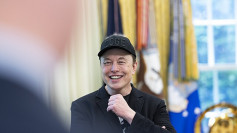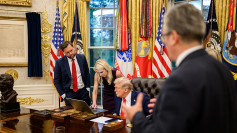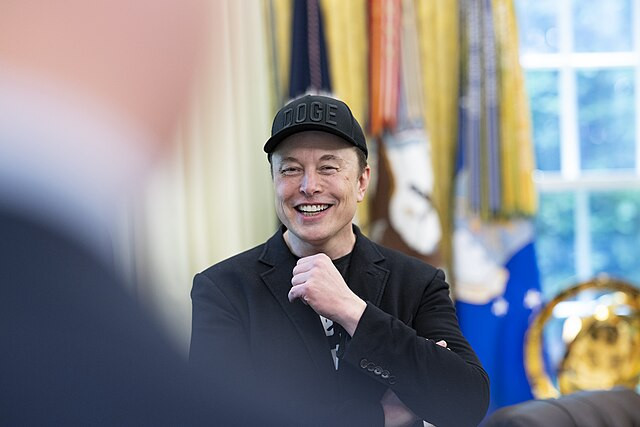
Elon Musk said he felt "foolish" about spending hundreds of millions of dollars backing Republicans in the midterm elections and rejected the MAGA label, distancing himself from President Donald Trump's movement after Democrats captured both chambers of Congress.
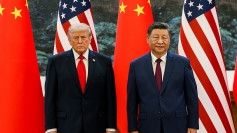
Speaking remotely from China at The New York Times' DealBook Summit on Wednesday, Musk said he would have spent less if he could make the decision again. He was accompanying Trump as part of the U.S. delegation.
"I feel pretty foolish about having spent so much money and not seeing much for it," Musk said. "But it certainly shows that American elections are not just about money. You can put a lot of money into elections and have an effect that's relatively minor."
Musk spent more than $445 million during the election cycle, according to campaign-finance tracker OpenSecrets. Much of the money supported Republican Ken Paxton's Texas Senate bid, which ended in a 12-percentage-point defeat to Democrat James Talarico.
The Tesla and SpaceX chief said his objective was divided government, with Republicans controlling at least one elected branch. He described a goal of securing 51 Republican senators in 2029, while opposing overwhelming control by either party.
"I think we want to have some checks and balances here," he said.
Asked by interviewer Andrew Ross Sorkin about his past support for MAGA, Musk responded: "I'm not MAGA."
He said he rejected the label if it meant unquestioning loyalty to Republican policies, arguing that both parties had strengths and weaknesses. He compared partisan allegiance to supporting a hometown sports team, with voters unwilling to acknowledge their side's failures or their opponents' achievements.
The remarks contrasted with Musk's earlier appearances in Make America Great Again hats and his role leading the Trump administration's Department of Government Efficiency. He left that position in 2025 following disagreements over administration spending policies.
Musk said he had devoted relatively little personal attention to the midterms because of his responsibilities at Tesla and SpaceX. His financial involvement nevertheless made him a major source of Republican campaign support as Democratic candidates drew substantial contributions from individual donors.
Raymond La Raja, a political science professor at the University of Massachusetts Amherst, said the scale of the Democratic wave limited what wealthy Republican donors could accomplish. He also argued that super PACs, which received much of Musk's money, generally spend less effectively than candidates' own campaigns.
Musk offered a favorable assessment of Texas Governor-elect Gina Hinojosa, despite his backing for Republicans in the state.
"The new governor, actually, I think is going to be quite moderate," he said. "I don't think she's sort of a far-left governor, and based on everything I've heard about her, I think everything will be fine in Texas with Gina as governor."
He also defended former Nvidia Chief Executive Jensen Huang, according to Variety. Musk compared removing Huang to "kicking Michael Jordan off your team," while acknowledging that the executive "certainly made some mistakes."