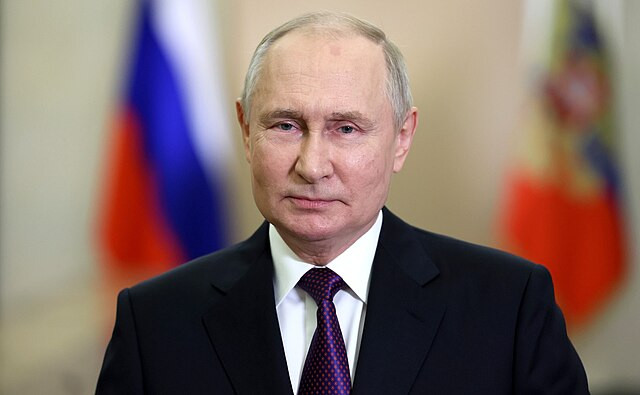
Russian President Vladimir Putin has reportedly told allies that failure to achieve his objectives in Ukraine could ultimately cost him his life, an assessment that The Economist says is helping drive the Kremlin toward further escalation as Russian forces struggle to secure decisive battlefield gains.
"They will hang me," Putin told allies at one point during the war, according to The Economist. The remark, if accurately reported, offers a stark indication of how the Russian leader may view the personal consequences of failing to produce an outcome he can present as a victory.
The Economist reported that Putin's assessment of his own vulnerability is an important factor in Moscow's calculations as the war continues without the strategic breakthrough the Kremlin has sought. The account doesn't establish when Putin made the remark or identify the allies who heard it.
The precise form of any new Russian escalation remains uncertain. Ukrainian officials expect Moscow to intensify drone and missile attacks during the winter, according to the report, increasing pressure on Ukraine's infrastructure and population while ground fighting continues.
Another option would be a substantial expansion of Russia's military manpower. The Kremlin could mobilize hundreds of thousands of additional troops, The Economist reported, despite the severe risks facing soldiers deployed to some of the most heavily contested sections of the battlefield.
The possibility of escalation increasingly extends beyond Ukraine. Lithuania, Poland, Latvia and Estonia have raised concerns about Russian sabotage and other hostile operations, reflecting fears that Moscow could test NATO countries without immediately launching a conventional, large-scale attack.
Reuters reported earlier this month that Lithuania was preparing for the possibility of a staged incident, while Poland, Latvia and Estonia warned about potential sabotage. The concerns have prompted governments on NATO's eastern flank to strengthen protection of infrastructure that could become vulnerable to covert or hybrid operations.
"We are not naive, we see the information, we read between the lines and we are doing our homework," Lithuanian Defence Minister Robertas Kaunas told Reuters.
Lithuania has deployed military personnel to support riot police protecting strategically important sites. Those facilities include a liquefied-natural-gas import terminal, an oil-products terminal, a major electricity connection with Poland and a hydroelectric facility, according to Reuters.
"We are increasing the security of our critical infrastructure, we constantly exchange information with our intelligence on what to do next," Kaunas said.
The deployments are also intended to communicate that Lithuania is prepared to respond if its territory or infrastructure is targeted. "We are clearly signaling that, if needed, we will be defending ourselves," Kaunas said.
Separate reporting has raised the possibility that Putin could eventually consider a limited attack against a NATO member intended to test whether the alliance would respond collectively. Such a scenario would represent a significant expansion of the confrontation between Russia and the West and potentially challenge NATO's collective-defense commitments.
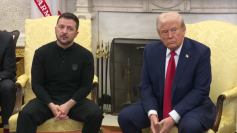
President Donald Trump has publicly dismissed concerns that Moscow is preparing to attack NATO territory. "There is no problem," Trump told Axios last week when asked about the threat.
Trump also played down CIA Director John Ratcliffe's unannounced visit to Russia, describing the meeting as "standard business" rather than an emergency mission intended to warn Moscow against escalation.
"Ratcliffe sees his Russian counterpart once every six months or once every year. They have a very good relationship. There was no message and there was nothing unusual," Trump said.
Asked whether Washington had privately warned Putin, Trump didn't disclose the substance of any communications. Instead, he said Moscow is "not going to attack NATO territory."