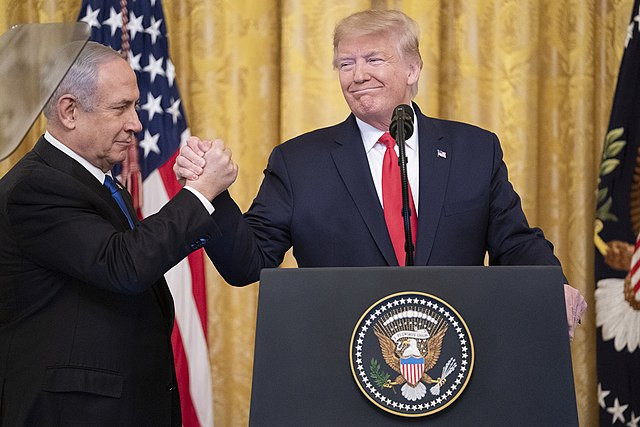
Israeli Prime Minister Benjamin Netanyahu says decades of appearances on American television helped him shape U.S. thinking about Iran, a striking acknowledgment of his long-running effort to influence Washington as questions intensify over Israel's role in President Donald Trump's decision to go to war with Tehran.
In a recent television interview, Netanyahu said it took years to convince the U.S. that diplomacy alone wouldn't eliminate the threat he believed Iran posed. He estimated that he had spent close to 1,000 hours appearing on American television, giving him both a platform to make Israel's case and extensive familiarity with the country's political system.
Netanyahu portrayed those appearances as part of a broader strategy rather than routine media exposure. He said his experience dealing with American political leaders-including those sympathetic to Israel and those less supportive-helped him understand how to influence opinion in Washington.
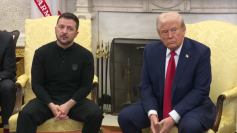
The comments have revived a politically charged debate over how much Netanyahu shaped Trump's decision-making on Iran. Iranian officials have seized on the remarks as evidence that Israel maneuvered Washington into the conflict, while Trump has explicitly rejected that characterization.
Netanyahu's campaign to push the U.S. toward a tougher approach to Iran predates Trump's presidency by years. One of its most visible moments came on March 3, 2015, when Netanyahu addressed a joint meeting of Congress to argue against the nuclear agreement then being negotiated by President Barack Obama's administration and other world powers.
That speech represented an extraordinary intervention by an Israeli prime minister in a contentious American foreign-policy debate. Netanyahu returned to the issue in 2018, publicly presenting Israel's case against Iran's nuclear program as Trump considered withdrawing the U.S. from the 2015 nuclear agreement.
The history makes Netanyahu's recent comments about his media strategy significant but doesn't by itself establish that he manipulated Trump into military action. His efforts were aimed at shaping a much broader American debate spanning multiple administrations, congressional majorities and presidential elections.
Charles Kupchan, a senior fellow at the Council on Foreign Relations, said during the program that Netanyahu had clearly influenced Trump's decisions. He pointed in particular to the close military coordination between the U.S. and Israel surrounding the conflict.
Kupchan, however, rejected the broader claim that Israel had deceived the U.S. or dragged an unwilling Washington into war. His distinction separates Netanyahu's demonstrated effort to persuade American policymakers from the more serious allegation that Trump was manipulated into taking military action he otherwise wouldn't have chosen.
Trump himself has disputed that interpretation. In April, the president wrote that "Israel never talked me into the war with Iran."
Trump instead attributed his decision in part to his reaction to Hamas's Oct. 7, 2023, attack on Israel and his longstanding position that Iran couldn't be allowed to obtain a nuclear weapon. His account suggests that whatever role Netanyahu played in shaping the broader debate, Trump regarded the ultimate decision as his own.
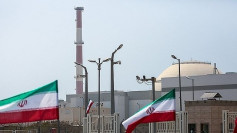
Iran has offered a sharply different version of events. Iranian Foreign Minister Abbas Araghchi on Aug. 31 accused Netanyahu of "suckering" the U.S. administration into fighting Iran on Israel's behalf and called the Israeli prime minister a "serpent."
Araghchi linked his accusation directly to Netanyahu's description of the roughly 1,000 hours he had spent appearing on American television. His characterization represents the Iranian government's allegation and isn't independently established by Netanyahu's comments.
The dispute has effectively produced three competing accounts of the same relationship. Netanyahu openly describes a decadeslong campaign to influence American thinking about Iran; Trump acknowledges his own hard-line position toward Tehran but denies Israel persuaded him to enter the war; and Iran argues that Netanyahu manipulated Washington into fighting on Israel's behalf.