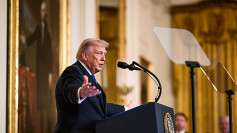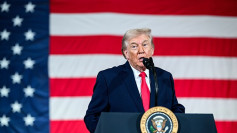
President Donald Trump closed the Republican Party's midterm convention in Dallas by asking supporters to raise their right hands and repeat a pledge to him to vote in November, an unusual exercise that underscored his effort to make congressional elections in which he isn't on the ballot a referendum on his presidency.
The Thursday night exchange at the American Airlines Center quickly spread beyond the convention after Trump led the audience through a call-and-response pledge that began with praise of himself, moved into another accusation of Democratic election cheating and ended with a promise to bring friends and relatives to the polls. He later warned supporters that if they didn't vote, "You go to hell, you know that."
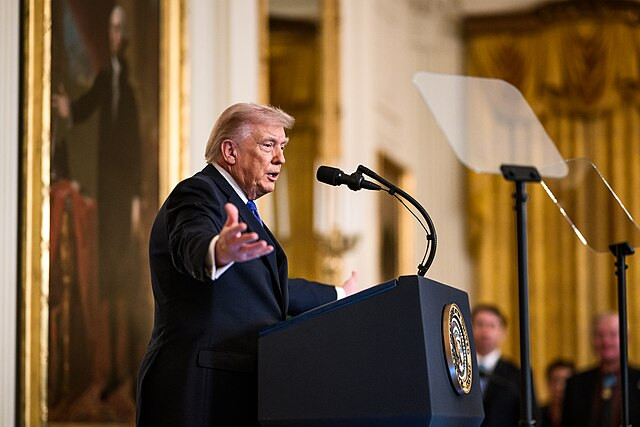
"So please raise your right hand," Trump told the crowd, raising his own hand. He then began: "I pledge -" before attendees repeated the words after him.
"To the greatest president in the history of the United States," Trump continued, pausing for the audience to repeat the line. "That loves us so much he can't even breathe."
The pledge then shifted to turnout. "That I will go out with my family, my friends. I'll do it anyway. I don't care if I'm registered or not, I'm gonna try and cheat like hell like they do," Trump said, before promising to get friends and family to vote Nov. 3 or cast their ballots earlier.
Trump has repeatedly claimed that Democrats engage in widespread election cheating, allegations for which he hasn't produced evidence showing fraud on a scale that altered the outcome of recent presidential elections. During the same speech, he again argued that Democrats oppose Republican-backed election legislation because "they want to cheat."
After the audience completed the pledge, Trump added another incentive to participate. "You know what happens if you don't vote?" he asked. "You go to hell, you know that." He followed with: "And I don't want that to happen to you, so please go and vote."
The spectacle generated immediate criticism online, where opponents described the hand-raising exercise as cult-like and focused on a sitting president directing supporters through a pledge that began by declaring him the greatest president in U.S. history. Supporters at the convention responded enthusiastically, and Trump presented the exchange as part of a turnout appeal rather than a formal oath.
The episode fit a broader strategy Trump displayed throughout the Republican gathering: putting himself at the center of the Nov. 3 elections even though voters will be deciding control of Congress rather than the presidency. On the convention's opening night, Trump explicitly asked Republicans to behave as though his name appeared on their ballots.
"When I'm on the ticket, Republicans always do very well," Trump told the Dallas audience Wednesday. "I'm asking you to pretend that I'm on the ballot. ... Just one more time." He later told them, "We're running together."
That message reflected a challenge facing Republicans as they seek to retain their House and Senate majorities: translating Trump's presidential-election coalition into turnout for congressional candidates. The Dallas gathering, the party's first national midterm convention, was designed in part to generate attention and enthusiasm during an election year that ordinarily wouldn't feature a presidential nominating convention.
Trump paired his turnout push with a far more tangible promise on the convention's opening night. He proposed giving every adult U.S. citizen a $5,000 "Trump dividend" if Republicans retain control of both chambers of Congress.
Such a program could cost roughly $1.3 trillion, depending on eligibility, substantially more than the tariff revenue collected so far that Trump has suggested could help finance it. Trump initially offered few details about how the payments would work or when Americans would receive them.
House Speaker Mike Johnson said Sunday that congressional authorization would be necessary, contradicting Trump's suggestion that the administration might be able to issue the payments without lawmakers approving them. Johnson said Congress controls federal spending and would have to act before checks could go out.
Trump, speaking from Ireland over the weekend, continued to argue that the government could afford the proposal, calling the payments "easy" to accommodate because of federal revenue. Details of the program-including eligibility, timing, legislative language and the precise source of funding-remain unresolved.
The two-night convention repeatedly returned to Trump's contention that Republican congressional candidates and his presidency should be treated as a single political project. In his opening speech, he warned that losing Congress would threaten Republican policies on taxes, immigration and public safety, while his closing-night pledge sought to convert that message into a personal commitment from supporters to turn out.