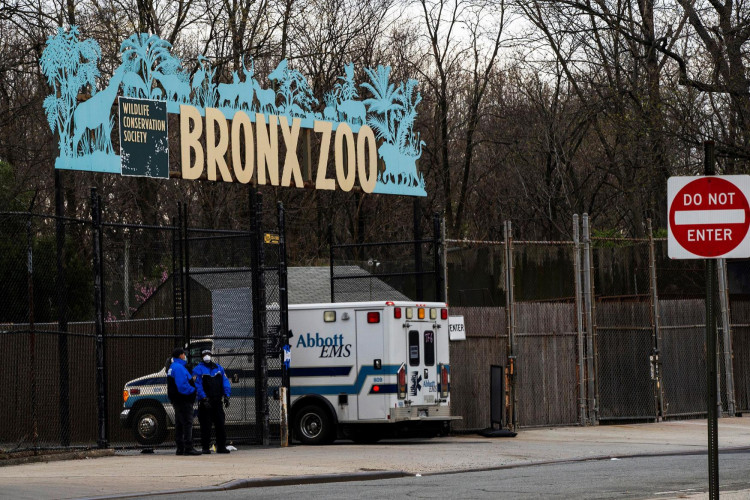
A tiger at New York's Bronx Zoo tested positive for the Covid-19 disease, the zoo's chief veterinarian said Sunday, marking the first reported case of a human-to-animal transmission.
Since developing dry cough along with three other tigers and three lions, Nadia, the four-year-old Malayan tiger, was screened for coronavirus disease, the Wildlife Conservation Society, which operates the zoo, said in a statement. The animals, it said, are expected to recover.
It is suspected that the virus which causes COVID-19 has spread from animals to humans, and a few animals in Hong Kong have been found to have contracted the virus.
Nadia is believed to have been contaminated by an asymptomatic zoo maintainer along with six other big cats. The cats started displaying signs late last month after exposure to the employee, who was not named.
According to zoo chief veterinarian Paul Calle, "this is the first time that all of us know that a human contaminated the animal and the animal got sick."
While the other tigers and lions showed signs as well, the zoo wanted to check only Nadia because she was the sickest and had started losing her appetite, so they didn't want to anesthetize all the animals, Calle said.
None of the zoo's other large cats - four other tigers, a puma, cheetahs, a snow and clouded leopards, an Amur mountain lion, and serval others - are showing any symptoms.
There have been rare cases of positive coronavirus tests for pets elsewhere in the world, but experts have emphasized that there is no proof that they will get infected or spread the disease.
The Wildlife Conservation Society said they have checked the cat with care and will ensure that any information they acquire about the virus will lead to the world's continued awareness of this dreaded disease.
The National Veterinary Services Laboratories of the United States Department of Agriculture reported the tests on Sunday and is collaborating with the Centers for Disease Control and Prevention to assess if animals will be screened for coronavirus at the zoo or in other areas.
There is no proof that animals are capable of spreading COVID-19 to humans, the USDA said in a statement, but the CDC suggests that people with the virus avoid contact with animals and pets.
Although there have been no reports of pets being infected with coronavirus in the US, the USDA and CDC say they will continue to keep track of the situation, but do not suggest that any animals be screened at this point in time.